Saturday, 4 March 2017

Dragon Flies around the Moon, Giant Penguins Once Waddled the Earth, Gifts from NASA


In a gracious gesture, NASA has released free access to software featuring new technologies.
Whizz - kids and Tech-heads will find plenty of inspiration in their PDFs.
The new 'space race' is hotting up as Dragon X announce the first commercial flight around the moon taking place next year, 2018.
Two people will be undergoing health and fitness tests for the milestone journey very soon.
The ultmate goal  for Dragon X is to transport people '...to Mars '.

Mimas  , no Death Star visible....pic NASA/ JPL-Caltech
Even in space with its mind - boggling distances , there are near - misses: recently, the Mars Orbiter had to be course - corrected to avoid collision with Phobos.
This may sound insignificant, but I was taken aback to learn that Mars is a busy ' highway' with no less than five vehicles in orbit.
Which led me to wonder how many were in orbit around our moon , and finally Earth  ( over a thousand )
Even Saturn is being buzzed -  by our intrepid explorer Cassini, which took the photo shown below.
Cassini is currently grazing the ring system around Saturn , observing and preparing for its ultimate demise when it plunges into the gas giant in September.

Saturn pic by Cassini       NASA/ JPL-Caltech
The above image of Saturn was taken by Cassini.
Pause for jaw-dropping fact - each  pixel equates to 37 miles...
 ...that's big.
Saturn is said to be a place where metallic hydrogen exists in the crushing pressure of the atmosphere.
Regarded as a ' Holy Grail ' of chemistry, its status is due to the fact it could be potentially used as rocket fuel, which makes Saturn a re-fuelling stop on the long journey to our next destination.
Attempts have been made to replicate the material under laboratory conditions , which have allegedly succeeded, but unfortunately, the only sample of metallic hydrogen in the world has gone missing .
As you can imagine this has caused great concern.
The extra difficulty in finding the missing sample is that it is one-fifth the thickness of a human hair.
Which is pretty small.
Regardless, though, baffled scientists are currently looking behind curtains and down the side of sofas.
So far, they have found thirty brass coins, a leaky biro pen, a washer , and a ticket to a Level 42 gig .

Meanwhile, back on Earth...

The University of Hong Kong have created a computer simulation of a flying dinosaur with four wings.
Also, fossil evidence of a giant prehistoric penguin  has been found  in New Zealand.

Finally, apropos of nothing,  I found this article very interesting. 


Please note - I have been guilty of occasionally linking to articles in Wikipedia. This has been pointed out as a highly unreliable source of information, which I understand - but in my experience, simple fact - checking against alternate sources is always the way to go. I trust that others will continue to do the same, as I don't intend to patronise my readers . Thank you for being here !
G

Saturday, 25 February 2017

Pseudo - Mammoths and Pedantic Planets


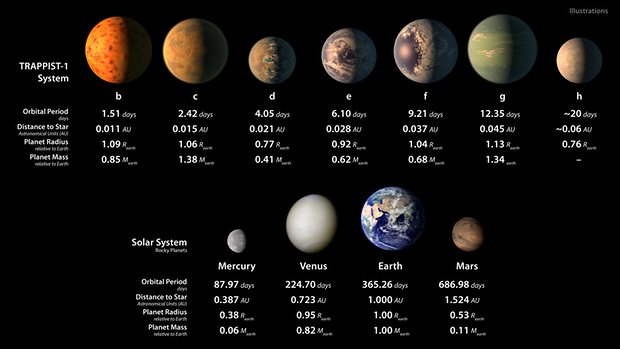
Seven Earth-sized planets ?                     image: NASA/JPL/ Caltech

Call me picky, but I'm already tired of reading headlines that say NASA found seven earth- sized planets.
Time to address my inner pedant -
Of the seven planets found, only three of them are in the goldilocks zone of potentially habitable worlds around their parent star , and only one of them is Earth-sized.
Fact.
If that makes me a party - pooping pedant, then so be it.
It's a great discovery, and certainly provides a focus for future science and exploration
But
They are also forty light years away
Which is not to be sniffed at.
My first reaction was that we should point a radio mast and send a signal out there
Which is great until you realise that your excitement would have to last for eighty years to get the signal back along with any message they might attach.
That's if  they respond immediately
And that is if they even exist
What if there's no-one there ?
Eighty years is a long time to wait for silence.
On the other hand - nothing ventured, nothing gained; 
and we  Earthlings are nothing if not curious.
I imagine plans are already afoot - after all with seven ( possibly more ) worlds to choose from...

Curiosity       image NASA / JPL-Caltech

So let's be positive - another NASA initiative is to use metal extracted from Mars to construct habitats, thus saving precious fuel and money .
I don't have anything more to discuss regarding Mars, ( I haven't even seen the film with Mr Damon*) but a dedicated planetary scientist published the above image of the Curiosity rover , taken at  (Martian)  sunset recently - which looks like a studio shot , or CGI.
Conspiracy a-go-go !


Human eyes are best for spotting 'planet nine'
....

With the demotion of Pluto to dwarf planet, there's still a planetary gap to be filled.
There is a candidate for a ninth planet , but it is so far away that it has not yet been found.
A new project allows citizen scientists to look for it.
Personally, I say we should still regard Pluto as the ninth planet.
Why ?
Because the new candidate is so far away that one orbit of the sun is estimated at 10 - 20 000 years.
That's a l-o-o-ong way out.
Whereas, we've already been to Pluto
New Horizons didn't actually leave a flag saying 'Property of Earth ',
but I grew up convinced of this distant little planet being part of our solar system
Okay so it hasn't cleared its orbit of debris  (that pesky kuiper belt), which disquaifies it from being a planet - even so, the whole planetary criteria thing was introduced in 2006 , by which time, Pluto had been a recognised planet for 76 years.
I say that what's done is done.


Back on Earth...


Interesting article here , although I despair at the clumsy word 'de-extinction ' ...
Anyway, the gist of the piece is that an  elephant / mammoth hybrid may be possible, which raises all sorts of moral questions; in this age of concern over animal welfare , do we really want to focus on novelty over practicality ?
If so , why not create a whole herd, after all these were gregarious creatures .
Then of course, there's the inevitable Jurassic Park question.
At which point, I say farewell until next time...


*- but I have seen Arrival and Interstellar

Tuesday, 21 February 2017

Why Not Ceres ?

Ceres 

I was conflicted about making this post for many reasons, mainly because I don't do mid-week posts, but here we are.
I decided to write this in advance of the proposed N.A.S.A. news release on 22nd Feb - not to ' rain on their parade' , but rather, to enhance the experience.
After all, the proverbial cat is out of the bag already, and I think the leak emanates from somewhere in Europe (details of the whole thing here ).
Personally, I'm disappointed, as it overshadows the quite astonishing news that organic matter has been found on the planetoid , Ceres.
Remember the Dawn explorer , and my previous excitement over the mysterious bright patches which turned out to be forms of salt from subsurface waters ?
Yes ?
Well. not those.
Apparently these organic materials are in an area surrounding a particular crater.
This is not the place to embark on fanciful theorising; but why should organic matter exist in one particular area ?
If the material is from a subsurface body of water, why is there no trace in other areas ?
I'm already letting my feverish monkey - brain get excited by a myriad of possibilities , but this, to me, is a perfect reason to explore further.
Ceres is the largest body in the asteroid belt between Mars and Jupiter, and I would argue that it warrants closer investigation - if the only concern is cost, it would surely be a fraction of any Mars expedition.
The previous link is a fanciful Bloomberg piece of speculation, but the idea is there.
Let's just concentrate on exploration rather than the plundering of minerals - after all , the assumption that it's there for the taking smacks of colonial era greed and ignorance - but we're better than that, right ?

Regardless, N.A.S.A. will probably tell us of the three Earth-like worlds orbiting a red dwarf  some 40 light years away; and that is genuinely exciting, especially when the chance of extraterrestrial life is introduced , but even with our best speculative technology, it would take us 60 years in a craft with an immense lightsail to get there, and only then if we could upscale the technology to make it a manned mission, rather than a postage stamp - sized craft.

Just to conclude, this post is my response to the imminent N.A.S.A. announcement - I think they are missing a point closer to home .
Ceres is on a par with Europa, Titan and Enceladus in the ongoing search for life.


Thank you for reading this far - normal service will be resumed in a few days !


Saturday, 18 February 2017

Amphibious Drones, Ancient Extremophiles and Superbugs in Space


Amphibious drones are go...

It's hotting up - big money prizes for first team to the moon , and the first to explore the deep sea.
The deep sea contest has a one-day time restriction, and it's got to be done by amphibious drone.
This could be useful for imminent  exploration of other worlds - but as I studied this article, I learned that we have only explored 5% of our own oceans. 
That stopped me in my tracks - mainly because at this point in our jaded , world-weary 21st century we must have explored everywhere on Earth ?
Nope, most of the oceans remain unknown.

Who knows what lurks...           detail from Carta Marina 1572

Exploration is underway in Antarctica , deep inside icy caverns where conditions are similar to Europa (ok, not that similar - temperatures on Europa would be way more frosty at -160°c )
Harsh environments provide serious challenges for exploration , and so JPL have a development facility for monitoring extreme environments , where they are developing robots that can crawl, scurry and climb .
I also learned that there is a department of planetary protection within NASA - is this a conflict of interest ?
Or is it a genuine watchdog for the many exploration methods that are being developed?

Perhaps the most bizarre news in terms of biological matters is that the MRSA bug - the 'superbug' as it was termed by the media in the uk when it created a scare recently, ( ...a bug that you could catch in hospital that was immune to all medicines!) is being sent to the ISS.
We are assured that it will be subject to serious, high-level containment - but anyone with a working knowledge of sci - fi knows how that plays out...

Apparently, space is being upgraded to broadband or something similar , with wider bandwidth enabling bigger images and information packets to be transmitted across the cold vacuum of space.
I'm glad, because I always have problems with my dial-up connection to Pluto.*
Which reminds me that there are many who won't know what I mean by ' dial-up' - and now, I feel old.

...meanwhile, down here on Earth,


  Strange life forms have been discovered embedded in crystals in a system of caves in Naica, Mexico
Dating back some 50 000 years, the living microbes are proof of the resilience of life in extreme environments (the Naica caves are 58°c, 99% humidity).
They are complex microbes, and their DNA differs as much from us , as we differ from mushrooms.
The specimens have been revived in a restricted environment (a lab)
So, that's all right, then , it's not as if we could ever be invaded by rocks...


* At the time of writing, it's 86 years since the discovery of sometime planet Pluto, so, happy birthday!

Friday, 10 February 2017

Robotic Eels, Citizen Satellites, Sky Cranes and The Frozen Lakes Of Mars

Develop and fly your own cube satellite with help from ESA !
Okay, it's not open to individuals , but university groups with a good design , deadline is March 5th, 2017.
Hurrah for ESA !
Citizen Satellites can't be far away...maybe let's practice with drones first.
For the very ambitious, there is the competition to reach the moon and be first to return selfies.
Twenty million dollars for the winner !
The final contestants will begin launching this year !

Whilst I'm impressed that they have developed a chip that can survive the hellish temperatures of the surface of Venus, I can't help wondering why they are so focused on replicating a Curiosity-type rover - surely at such high temperatures a different style is called for
Why not have a hovering rover with extendable probe for surface samples.?
Or a completely separate autonomous drilling  unit ?
Would a drone be feasible , controlled by a remote signal from a satellite in the upper atmosphere ?

This is the problem with astro-physics - for all the compliments paid to the film Interstellar for its realistic depiction of a wormhole, has anyone actually been through one ?
Can a black hole be replicated under lab conditions ?
No, so everything is conjecture.
By the same token we are in danger of imposing limits on our own potential
There is the saying, that 'If it ain't broke, don't fix it.'; which is fine to an extent, but no-one ever pushed the envelope by staying in their comfort zone.
On re-reading this paragraph, I think it is unclear - what I'm trying to say is, let's get wild with spacecraft designs.
I don't want to lapse into business speak with ' blue- sky- thinking -outside- of -the-box', but here's an example of a box to think outside of...

Europa lander...   artist impression      NASA / JPL-Caltech

I'm not saying that landers should be aesthetically pleasing
And I understand that huge doses of radiation from Jupiter is a very real threat, so a shielded box is a smart thing,but...
But there's something - dull about it.
It's retro, but not in a good way.
Even the pareidolia of the robot 'head' looks naff.

STOP PRESS
Further reading tells me that the pictured lander is just an early prototype
It would drill beneath the surface , but only a few inches, as opposed to the miles of drilling needed to reach the ocean,
I stand corrected.
Further details
I'm still not convinced by the drilling theory - I hope further exploration might reveal a hidden shortcut, perhaps a deep gully / ravine, or better still, a system of caves.
My conjecture.

I remember reading of submarine probes based on the fact that any life on Europa is likely to be beneath the waters - even the recently developed robot - eels look appropriately ...alien.
I understand the practical necessity to assess land-based minerals for their extraction value, but are we not limiting our potential in exploration terms ?
Send in a couple of the very cool robotic eels.

There is an issue, of course - given the current attention paid to avoid contaminating potential water sources on Mars , why would we send technology into an alien ocean ?
Is it not running the risk of breaching the Outer Space Treaty ?


Mars continues to confuse.
Curiosity has ample evidence of lake beds which once were filled with fresh water , yet the lack of traceable co2 in the atmosphere suggests the water was always frozen, and never achieved a liquid state . Bizarre...


If you saw the film Gravity, then this picture probably resonates .
It's a photo from the first 'untethered'. spacewalk , showing Bruce McCandless
Not so futuristic after all - this picture is from 1984
Don't panic , he got back safely - phew !


Don't look down


Sunday, 5 February 2017

The Dunes of Mars, Bennu, Blazars and Cats in Boxes

It's official - being in space can alter your DNA !
Expect returning astronauts to resemble giant rubber - suited monstrosities of yore
Actually, nothing so dramatic, but there is evidence of unexpected alterations .
This could have major implications for long, manned journeys - to Mars, for instance.
Speaking of which, a recent image shows the dunes in the northern hemisphere of Mars - fun facts; whilst perusing the photos, I became aware that there are different kinds of dune - I am guilty of thinking how one pile of sand was pretty much like another.

Mars - Pahrump Hills - Curiosity                  pic NASA /JPL-Caltech


The image below had me confused for some time, and shows the problem of pictures without objects of reference for scale ; to be fair, Mars is rather short of monuments and landmarks to judge scale by - I thought that this was just a close up of a dry riverbed with cracked mud...but apparently some of the thin ridged areas are 16 storeys high.

Mars image by HI RISE        NASA/ Caltech / University of Arizona
A new test for biosignatures has been developed, which is 10,000 times more sensitive than those onboard Curiosity.
The article which mentions this discovery also name-checks Europa as a suitable target for testing, In preparation of which, this piece describes a proposed lander for Europa .
Personally, I'm disappointed that it looks so - underwhelming.


The tiny blue smudge in the centre is our solar system...

The illustration above shows our solar system compared to the largest black hole yet found.
Don't fret, it's not actually swallowing us - it is 12.1 billion light years away , thankfully.
Of course, given its immense size and the voracious appetite of black holes, it may well munch its way here, like a giant Pacman*...
This supermassive black hole is part of an immense quasar - if it were 280 light years away from us, it would give us heat equivalent to the sun.
I am now feeling small and insignificant , still banjaxed by all the big numbers involved , so in order to preserve my sanity, I will extricate myself from the event horizon of this monstrosity (diameter of 236.7 billion kilometres)


In a previous post , I mentioned the exciting project which would use lightsails powered by sunlight to achieve incredible speeds reaching 20% the speed of light, and enabling exploration of Alpha Centauri within a mere 20 years.
The caveat to that was the lack of a braking system - obviously a craft travelling at 60,000 km/s without brakes could have a problem with landing...
It turns out they have worked out a way to slow the craft down - although this will also affect the overall speed, bringing it down to a 95 years journey rather than a mere 20 years, so it becomes a generational thing.
Which means if you're travelling with Virgin Galactic , don't get a return.
Unless they solve longevity, too.
Which maybe connected to this earlier piece.
Longer telemeres, longer life ?

More immediate space exploration is the Bennu mission which aims to return sample material from an asteroid to Earth, with contact planned for 2018.
The Bennu-Rex explorer is also tasked with discovering whether Earth has any 'trojan' asteroids following its orbit.
This could unlock details of our distant past , as potential asteroids would likely be composed of material dating from Earths creation.
This little ' side-mission' is happening now ( Feb 2017)


If, like me, you've been struggling to understand quantum mechanics, there is now  a Ladybird guide to the strange , but inevitable realm.
Before you ask, the answer is no - I still don't understand it .
Cats in boxes ?
Yes - and no.
At the same time.
That's quantum .


Until next time, keep it ...erm...in a state of flux.


* Showing my age here, is Pacman still a thing ?

Friday, 27 January 2017

Giant Otters, Rogue Worlds, And Extrasensory Moments

A new theory tells us that planet Earth may have been hit by a rogue world long ago - infact, during the Late Heavy Bombardment  (yes, there really was such a thing!)
Apparently , the planets of our solar system were originally in a different order, but scattered like balls on a snooker table after a strong break: except , very slowly.
So where is the culprit planet , the cosmic cue - ball that set everything in motion ?
Apparently it is now debris, adrift in the asteroid belt between Mars and Jupiter - well , that's the theory.

Meanwhile, in a laboratory...

The image below is from an article about scientists managing to maintain a substance as liquid below its freezing point.
Shrödingers substance ?
It is solid and it's not at the same time.
Quantum , anyone ?
I may have mentioned my theory that the world has been distinctly weird since the upgrade and restarting of the Large Hadron Collider in 2015, and I still believe that is true .
Well, as true as anything can be in this weird new reality where terms like post - truth and alternative truth are commonly used...


A recent study finds evidence of widespread synaesthesia, with many more people than expected attesting to have experienced the sensory crossed wires of synaesthesia.
I think it is a result of our constant use of multimedia - and as we progress to a world of communication by symbols and gestures, isn't it inevitable ?
Still - a new sense can only be good...


Giant otters once roamed the Earth .
Fossil specimens found in China have proved perplexing - mostly because why would an otter be so big ?
Seeking some form of context, I followed a timeline
This puts the giant otters in the Miocene era, a time when mammals became well established, giant sloths were nibbling leaves on the tree tops. sabre - toothed cats roamed the land, and giraffes and hyenas appeared for the first time
I imagine the only real threat came from the sabre-toothed cats - being the size of a wolf would be an advantage.
Which brought me to thinking of evolutionary adaptions - we are now capable of creating unique lifeforms
Adding two letters to the genetic code of e. coli microbes might not lead to a Jurassic Park scenario , but it's a start.
I had to interrupt my palaentological detective work, as it was yet another online rabbit hole; a depository of amazing information, but also a bottomless mine of trivia - sigh.
Time to get back to the world of hard facts, I thought - not idle speculation.
Difficult though, as I learned that the universe is probably the playground of super - intelligent robots.
Will we ultimately create AI that is self replicating , and determined to conquer the cosmos ? - if so, does that reality already exist ?

Eagle crater pic NASA / JPL - Caltech


It's now thirteen years since the Opportunity rover landed on Mars and crawled out of a crater to begin exploration of the Red planet.
Still going strong, it has surpassed all expectations.
Its companion , Spirit , sadly ceased contact in 2010 , but both rovers exceeded expectations, lasting way beyond their original remits.
Opportunity was to last 90 sols , but it still operates, albeit with a software upgrade to its flash memory storage in 2015, just before it entered Marathon Valley.
It is currently the longest operating offworld explorer ever - so let's get those medals ready...


Until next time !