Showing posts with label Cassini. Show all posts

Sunday, 8 April 2018

When A Fish Is A Rock, Space Pioneers, And Magnetic Birds Eye Views

Todays brief blog comes to you courtesy of my spare 'back-up' spectacles, which, to coin a phrase, are 'bloody useless', so please bear with me -

Artists impression  NASA/ D. Guidice
Today is the anniversary of the launch of Pioneer 11 which became the first craft to fly through the rings of Saturn, testing the journey for possible problems prior to the later arrival of Voyager 1 and 2.
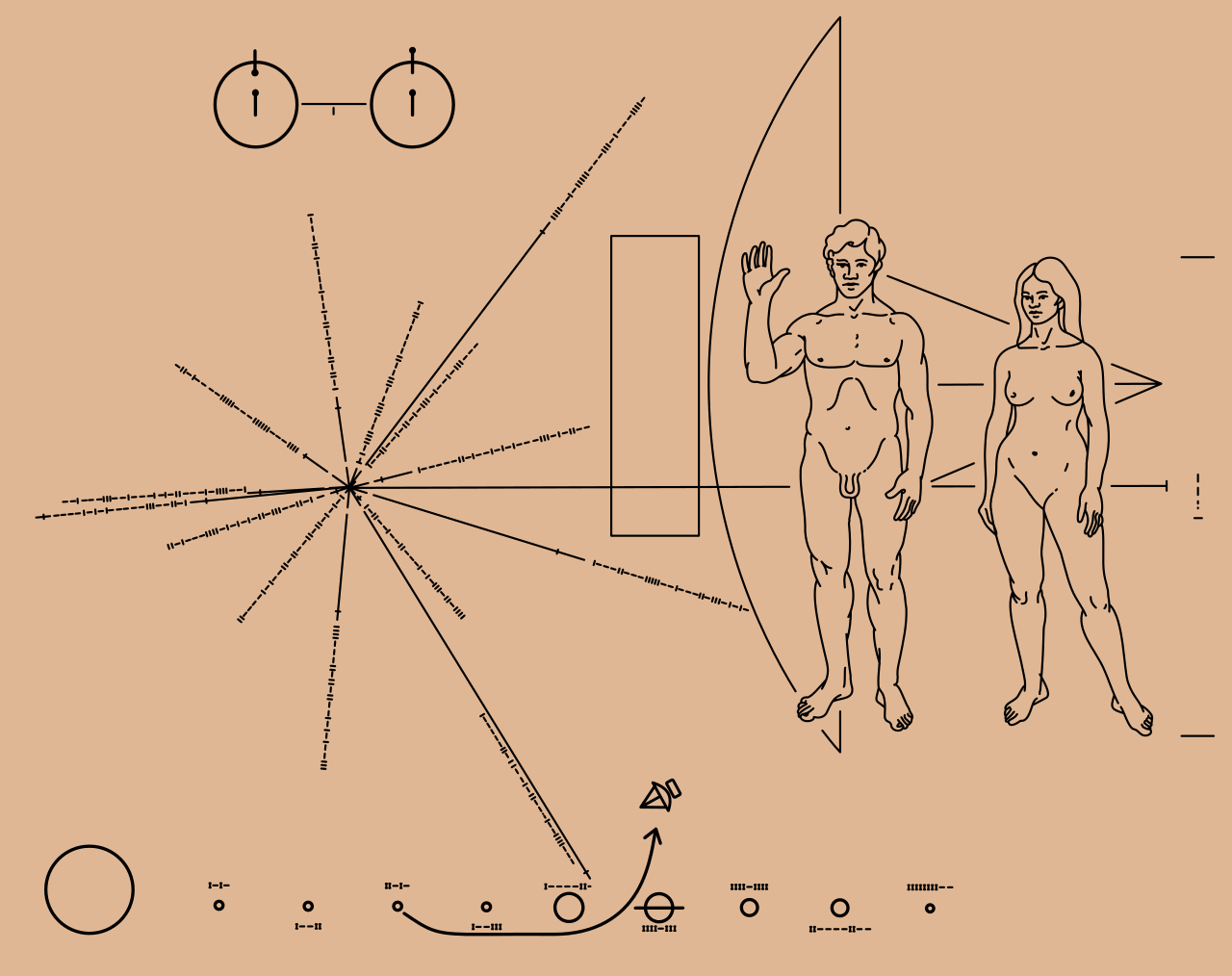
The pioneering Pioneers 10 and 11 also carried the plaques suggested by Carl Sagan as a form of potential greeting to any curious lifeforms...Voyager 1 and 2 went further (literally) , with the inclusion of the 'Golden Disk' containing Earth sounds, music, etc.
The only issue is whether our alien friends exist,* and if so, do they have a record player ?...I presume the next explorer craft will just carry a link to a streaming service....
The Pioneer spacecraft were powered down in 1995 following 22 years of exploration, and are now  far away, drifting towards a distant constellation - no dramatic Cassini - style plunge into a planet for them, just a slow drift into eternity ( unless an alien intercepts them and posts them back to the 3rd planet from Sol...)
The plaque on Pioneers 10 / 11... complete with address details
On the subject of historic launches - Virgin Galactic successfully tested their low- orbit craft a few days ago, (following the tragic attempt in 2014 ) , and are now in the burgeoning field of commercial spaceflight- it's getting busy out ** there, with a space hotel*** promised for 2022, as well as the many satellites being launched
Book now before the view of Earth from space becomes pertmanently obscured !
(...you know that feeling when you have just one chance to take the perfect shot of a beautiful view, and someone gets in the way ?)
Yeah, that one - so book now !
The day will come when people confess that their photograph of Earth is only clear of debris thanks to the use of Photoshop ™ - (sad emoji)
Birds have no such problems - in  recent news releases it appears that our feathered friends can actually see the Earths magnetic field in some fashion., using a protein known as Cry4...

*Great comic page from ' The Nib', reminding us that (for instance) the chemical signature of a fish could be the same chemical signature as a rock - so let's not be over-excited about exo-worlds 

** I'm never really sure whether it's 'out ' there or 'up' there...hmmm

***Catering in the space hotel may well be using salad crops / vegetables of the kind grown recently in Antarctica by German researchers

Tuesday, 17 October 2017

When Stars Collide, Hyperloop Pods, Propellors and Quantum Catapults

Apparently, half the missing matter in the universe has been found.
I breath a sigh of relief, as I'm sure we all do.
Personally, the idea of dark matter and black holes gives me a sense of deep dread.
All that nothingness...(shivers)

One hundred and thirty million years ago, when dinosaurs roamed the Earth, two neutron stars collided.
In August, the signals from that event reached Earth, and became the first ever visual and gravitational record of such a cosmic cataclysm.
The visual and gravitational records arrived within 17 seconds of each other, which is pretty damn good for a journey spanning aeons* of time...

The image below looks underwhelming, but don't forget that you're looking at an event that took place long before we existed...

NGC 4993     When Stars Collide                   NASA/Swift
Personally, I'm still reeling with the simple fact that telescopes are time machines...
What we need is a quantum catapult, enabling us to cross the vast divide of space and time.
I'm working on it, but I need more elastic for the catapult.
It's a minor inconvenience - I'm sure Elon Musk could sort it out - speaking of whom, in a recent discussion of his hopes to use rockets as glorified 'airliners' on Mars, he displayed a masterful use of terms like 'rapid unscheduled disassembly' (rocket explodes) , and ' ...getting somewhere in thirty minutes by rocket...will be negatively affected if ...' you might die', is on the ticket.'
Fear not, though, as current tests for his (Earthbased)  hyperloop system are exceeding their own speed records, and it won't be long before intercity journey times are vastly reduced.

Google have expanded their maps to include places in our solar system: enjoy, but please don't confuse them with your own GPS...

'Propellor' imaged by Cassini    NASA

Remaining with our own corner of the cosmos, I found this article interesting, as it ponders a few discoveries of the belated (do we use this term for a spacecraft? ) Cassini, particularly the interesting 'propellors' created by moonlets in Saturns rings.
A world with moons named from figures of Greek mythos , including Janus, Pandora, Atlas, Dione and Prometheus is always worth revisiting, although my personal favourite is the little oddity known as Pan...


35km wide Pan...


Don't forget there is a little time left ( closing November 1,2017 )  to include your name on the Insight flight to Mars - get your boarding pass here
Not sure if I got a wing seat, knowing my luck, I'm probably in baggage...


...but I'll  see you there


* Using aeons as a fluid measurement

Sunday, 17 September 2017

Cassini, Future Missions, And The Paradox of Time-Travel


Jean Dominique Cassini 1625-1712 first discovered four of the moons of Saturn


Cassini is no more, a moment I watched with a glass of Absinthe - the cloudy liquid resembled the swirling atmosphere of Saturn - that was my excuse, anyway.
It lent a strange ambience to the last hour of the mission, and I sensed the bittersweet feels of those who had spent so much time on the amazing voyage of discovery.
But enough - I could go on at length, about how its discoveries had been attended and enabled by so many dedicated people that it really felt like the perfect antidote to world-weariness, how it left me with a sense of pride in the potential of our eternal curiosity, and thirst for knowledge.
With this in mind,further missions to Saturn and its moons are being considered, with two contenders earmarked for Titan and Enceladus, the possible life - bearing moons.
Here is a link to a pdf of the Cassini legacy
Sadly, the next proposed launch to Saturn is a few years away - but don't forget Juno is in orbit around Jupiter*, the next Mars probe will leave next year, and Bennu / Osiris- Rex is also already underway-the daring mission to collect and return with a sample from an asteroid.
Don't wait up for the sample - it won't be back on Earth until 2023.

Goldstone, which rec'd the signals from Cassini

Speaking of distant worlds (okay, that's a tenuous link), in a turnaround for the world of radio telescopes, it has been determined that Earth is in the visual sightline of at least nine exo-worlds, so they could be watching us...**
Pointless trivia perhaps, but it shows the sort of thing that occupies the mind of bored scientists.

Intrepid engineers at the University of New South Wales have developed the 'flip-flop' quantum qubit, which could be controlled electrically rather than magnetically, allowing for the speedy development of silicon - based quantum computers.
The most impressive aspect for me is the fact that the entangled particles can be manipulated whilst remaining entangled.

I decided that the occupants of the ISS are technically, time- travellers.

It transpires that time travel is possible, but only forward, really (to avoid all those pesky paradoxes  - as explored in films like Back To The Future- i.e.if you went back in time and killed your grandfather, then you would not be born so you couldn't travel back in time, etc)
To keep everything tidy, then, only future time travel is allowed.
Except, apparently, if you could manipulate a wormhole - then it would be theoretically possible to travel back in time, but only as far back as the beginning of the wormhole.
Could quantum entanglement be used to create a nano-wormhole between two entangled particles ?
I decided that whilst it may be possible in the quantum realm, it could never be upscaled for common use.
Then it was time to lie down quietly in a darkened room...


Until next time

G


* Jean Dominique Cassini was also first (with Robert Hooke) to observe the Great Red Spot on Jupiter

** It has already been pointed out to me that they would be looking at dinosaurs. Thank you, Pedantic Interwebbers


Monday, 11 September 2017

Countdown For Cassini, Plumes on Enceladus, And The Pale Blue Dot


The Countdown for Cassini nears its end - only a few days now to its 'Grand Finale' , following an epic twenty years of exploration in the Saturnian system, and some truly amazing finds-
as well as releasing the furthest ever man- made probe to land on another world (when Huygens landed on Titan), Cassini has also relayed a treasure trove of new knowledge about the mysterious gas giant and its moons - eye opening stuff, like the amazing plumes of water on Enceladus - tantalising and interesting enough to have sparked further exploration
The proposed Enceladus Life Finder- ELF mission is a possible contender in 2020 - the other being LIFE, which is intended to bring samples back to Earth - but we all know how that plays out......

Cassini dived through the water plumes on Enceladus in 2015

Not to be out done (by themselves), NASA simultaneously released the news that the Hubble telescope had seen water plumes on Jupiters moon Europa.
The legacy of Cassini will be covered in its final moments, more thoroughly than I can, so I will restrain myself from further outpourings - but I am proud and humbled to see such wonders in the heavens - proof of what can be achieved when humanity sets aside the petty politics and squabbles that consume so much energy.
The final 'swan-song' dive will furnish us with further science, and for that, I am grateful.

It's forty years for the two Voyager craft in space, and with Voyager1 now travellimg outside our solar system (40,000 yrs until the next star) , it's up to New Horizons to clinch the next rendezvous as it fast approaches the mysterious object MU69 - ok, so fast is relative with MU69 penciled in for a flyby in 2019, but in space terms, that's soon.
It also promises to be the closest flypast yet.

The journey of the Voyagers has blazed a trail, forcing us to upgrade our listening capabilities as they get further away, and let's not forget that the Voyager craft also produced the first images of planets in our solar system that were more than fuzzy blobs - and also the famous image of Earth known as the 'pale blue dot', taken by Voyager One in 1990:

'The Pale Blue Dot' -    Feb 14 1990  NASA/JPL


Sunday, 3 September 2017

The Asteroid With Two Moons, Water On Mars, Distant Sounds, and The Octopus Invasion


A couple of days ago, a large asteroid named Florence flew past Earth, frighteningly close.
I didn't panic though as ' frighteningly close', in space/media terms is apparently 4.4 million miles away.
Phew, huh?
The media made much of the fact that it was the largest ever asteroid to pass by so close, and no doubt, some cultists and survivalists prepared for the Endtimes.
NASA even got footage that shows the asteroid had two moons !
I never thought that an asteroid would have any form of moon, but I suppose it depends on the size of it, and the strength of its gravity/magnetic core.

In other news, a further cluster of radio signals known as FRBs have been detected .
Emanating from the source FRB121102, a galaxy some 3 billion light years distant, the significance and origins are unknown - although one fanciful idea is that they represent the launch of deep space craft.
If that is true, then they left when our world was just beginning to host single - celled life forms...
by my own calculations, if they have been able to maintain their course, then technically, they are here already.
In which case, our only hope of survival is that they forgot why they left their home galaxy 3 billion years ago.


Meanwhile, in the rings of Saturn...

We are getting close to what's billed as the 'Grand Finale' , when Cassini plunges into the atmosphere of Saturn , bringing to an end its incredible voyage of discovery.
I shall be watching on September 15th, until we lose contact.
I'll miss the news from Cassini.

Is it a thing that we now humanise robot explorers ?
I feel a simiar empathy with Curiosity.
I remember the tense landing, billed as 'seven minutes of terror'.
Since then, I've been acutely aware of the reality of the lonely rover which is tirelessly cataloguing the environs, atmosphere and geology of Mars

Lest we forget:     Image from Opportunity           Sol 4824

Curiosity even has its own Twitter feed (shameless plug also for the Sarcastic Rover, which blends world - weary cynicism with wry political comment).
As well as Curiosity, let's not forget Opportunity , still trundling around Mars, long after landing on the 'Red Planet'.
Landing in 2004, both Opportunity and the Spirit rover had a projected three months of exploration on Mars.
Spirit lasted six years, and Opportunity, not to be upstaged by Curiosity, is still trundling around the Endeavour crater.
The next Mars launch will be Mars Insight, a static explorer tasked with sub-surface examination, which will launch in May 2018, followed by the Exo-Mars rover in 2020.
It's all systems go for Mars, we'll soon have many explorers / orbiters in action there, spurred on by the fact that water, one of the key ingredients for life, has been spied on Mars.
Let that sink in.
'briny water-flow' on a Mars hillside    NASA/ JPL / Caltech / Univ. of Arizona


Meanwhile, back on Earth...++++++++++++++++++++++++++++++++++++++++++++++++++++++++++++++++


The largest x-ray machine in the world recently started up in a 38 mile complex of tunnels beneath Hamburg.
Boasting 37,000 pulses a second, it will be used to examine the process of photosynthesis, unravelling the mystery of how light becomes energy - also how antibiotics are formed, and what happens deep inside the sun.

Apparently, octopus (octopi?) are taking over the worlds oceans 
On the subject of water, scientists have apparently succeeded in quantum communication in sea-water.
Okay, so the test was only over a ten foot distance, but even so ...


Saturday, 5 August 2017

Jumping Lunar Bots, And The Methane Seas of Titan

The mystery 'island' on Titan 

Recent news of complex, possibly life - capable molecules in the upper atmosphere of Titan got me a little excited.
Putting two and two together, and making five, I remembered a brief flurry of interest when images emerged of a vanishing something in the hydro-carbon sea of Ligeia Mare.
This was made even more intriguing by a documentary* about Titan which , in the final moments (start viewing at approx 35.24), examines micro-organisms thriving in Pitch Lake in Trinidad , the  closest thing on Earth to the hydrocarbon / methane lakes of Titan (minus the below- freezing temperatures).
 In the film,Dr Sarah Hörst replicates the conditions of the Titan atmosphere, successfully creating four major components of DNA, and a Dr McKay postures that life in such a nutrient - poor environment may take the form of a large, thin mat, maximising surface area...

Another anomaly on Titan is the cloud which shouldn't exist ( by our understanding, anyway)
These discoveries, and many more, were made by Cassini, the intrepid little probe that's been examining the Saturn system for twenty years ( and makes its final swan dive through the rings of Saturn next month).
The 'impossible cloud' , Titan      image  NASA/ JPL
I feel humbled, remembering the hugely impressive feat of the ESA probe Huygens being sent from Cassini down to the inhospitable surface of Titan in 2005, where it lasted just over an hour.
It remains our furthest landing on a planet in the solar system to this day.
Okay, there was the comet too, but that was just passing through, right ?
We are now agog at the wonders of Enceladus and Europa , both of which appear to contain large amounts of water, and great potential for life - or at least pre-biotic** conditions
Regardless of the possible existence of strange hydro-carbon based life forms , the sheer wealth of information gathered by Cassini has greatly increased our understanding of the Saturn system, and I will be drinking a farewell toast when it finally descends into the Saturnian depths...


Meanwhile, closer to home, a recent competition has resulted in the creation of jumping lunar nanobots.


The article speaks of profitability and rugged design, but I know that secretly, we're gearing up for nano-robot races on the moon !

Coming Soon - for those in the U.S.A. Once in a lifetime total eclipse of the Sun on the 21st August! To be extensively covered by NASA, I just leave this link here


*  Thanks to PlanetDr / SarahHörst for the link

**This seems to be the new buzzword

Sunday, 23 April 2017

Space Waste and an Aurora Called Steve...


Opportunity heat shield         NASA

There is a crater on Mars , recently imaged by the Mars Reconnaisance Orbiter, which contains detritus from the 2004 landing of Opportunity.
I got to thinking that we have already begun leaving our waste on other worlds
The moon has over 70 space vehicles, including buggies and landers, golf clubs, discarded boots, flags, and various - over 100,000 pounds of debris.
I looked for statistics regarding waste on Mars, but beyond this list, it gets into alien conspiracy territory, so I quickly back-tracked.
Let's not forget the ring of debris orbiting our own planet - some 500,000 pieces (according to NASA in 2013).
Add to this the many Russian Verbera modules on Venus - although I imagine they've been cremated and crushed to a pulp, so at least there should be no trace...
Mercury didn't escape so lightly in 2008 , when the Messenger craft impacted, creating a whole new crater.
Mercury imaged by Messenger               NASA
Currently surveying Titan for the last time, Cassini will eventually descend into Saturn, although given the toxic nature of the atmosphere, it will almost certainly be destroyed - and let's not forget the two Voyager craft, heading into deep space, followed by New Horizons, which achieved the most distant rendezvous yet with its flypast of Pluto, and following its encounter with MU69 in 2019, will become so much hi-tech driftwood floating through the heavens.
Our faltering steps into space have already left quite a trail , like a bored passenger tossing trash out of a car window on a long drive.
We humans are a messy bunch, but until we get the bill from the Intergalactic Sanitation Engineers, we'll be none the wiser.

On a lighter note , a new discovery in the majesty of the aurora ; a trail of green and purple lights which have been given the name of Steve.
No mushrooms required.


G

Saturday, 4 March 2017

Dragon Flies around the Moon, Giant Penguins Once Waddled the Earth, Gifts from NASA


In a gracious gesture, NASA has released free access to software featuring new technologies.
Whizz - kids and Tech-heads will find plenty of inspiration in their PDFs.
The new 'space race' is hotting up as Dragon X announce the first commercial flight around the moon taking place next year, 2018.
Two people will be undergoing health and fitness tests for the milestone journey very soon.
The ultmate goal  for Dragon X is to transport people '...to Mars '.

Mimas  , no Death Star visible....pic NASA/ JPL-Caltech
Even in space with its mind - boggling distances , there are near - misses: recently, the Mars Orbiter had to be course - corrected to avoid collision with Phobos.
This may sound insignificant, but I was taken aback to learn that Mars is a busy ' highway' with no less than five vehicles in orbit.
Which led me to wonder how many were in orbit around our moon , and finally Earth  ( over a thousand )
Even Saturn is being buzzed -  by our intrepid explorer Cassini, which took the photo shown below.
Cassini is currently grazing the ring system around Saturn , observing and preparing for its ultimate demise when it plunges into the gas giant in September.

Saturn pic by Cassini       NASA/ JPL-Caltech
The above image of Saturn was taken by Cassini.
Pause for jaw-dropping fact - each  pixel equates to 37 miles...
 ...that's big.
Saturn is said to be a place where metallic hydrogen exists in the crushing pressure of the atmosphere.
Regarded as a ' Holy Grail ' of chemistry, its status is due to the fact it could be potentially used as rocket fuel, which makes Saturn a re-fuelling stop on the long journey to our next destination.
Attempts have been made to replicate the material under laboratory conditions , which have allegedly succeeded, but unfortunately, the only sample of metallic hydrogen in the world has gone missing .
As you can imagine this has caused great concern.
The extra difficulty in finding the missing sample is that it is one-fifth the thickness of a human hair.
Which is pretty small.
Regardless, though, baffled scientists are currently looking behind curtains and down the side of sofas.
So far, they have found thirty brass coins, a leaky biro pen, a washer , and a ticket to a Level 42 gig .

Meanwhile, back on Earth...

The University of Hong Kong have created a computer simulation of a flying dinosaur with four wings.
Also, fossil evidence of a giant prehistoric penguin  has been found  in New Zealand.

Finally, apropos of nothing,  I found this article very interesting. 


Please note - I have been guilty of occasionally linking to articles in Wikipedia. This has been pointed out as a highly unreliable source of information, which I understand - but in my experience, simple fact - checking against alternate sources is always the way to go. I trust that others will continue to do the same, as I don't intend to patronise my readers . Thank you for being here !
G

Friday, 31 July 2015

Spaceship Graveyard

What happens to robot explorers when they die ?

There is no fabled final resting place like the elephants graveyard yet.


Curiosity landing site on Mars. 
Following the Pluto flypast which gave us a plethora of new information (still being assessed / downloaded),
New Horizons is now heading for the Kuiper belt, and with further funding,  possible analysis of another object - before it powers down , leaving us with a hunk of junk drifting in space, billions of miles away.

I personally hope that it continues for many years, but the truth is that we're lucky New Horizons didn't get struck already by space debris - and given the prevalence of random stuff in the Kuiper Belt, the odds are stacked against it.

Image taken from here:


Powered by Plutonium (ho-ho, almost funny), New Horizons is currently set to rendezvous either PT1 or PT3, (PT2 was eliminated).
The difference is that PT1 is smaller, but closer, therefore requiring less fuel, whereas PT3 is bigger but further away.
If the latter is chosen then the flyby is scheduled for 2019, at which point the fuel onboard should expire, and New Horizons will be freefloating.


Sadly for New Horizons, unlike the explorer Cassini, it will not be given a final blast of glory .

Cassini is currently tasked with photographing the moons of Saturn.

Cassini , should it last , will be repeatedly thrust through Saturns rings before plummeting down into its atmosphere at an incredible speed.,
A fiery send off in a blaze of glory, then.

Philae, the much beleagured lander on comet 67P may similarly go out in a blaze as the comet reaches its perihelion with our sun in August, erupting in a halo of ice and flame.

But New Horizons will just become smaller and smaller on the cosmic horizon, until, like Voyagers 1 and 2 before it, it's gone.

At this point, I should say that it qualifies as the first ever craft to approach Pluto system on a flypast, and its discoveries have been unrivalled.


And oh yes, I almost forgot - oops

There's also Curiosity, the Mars lander.
.
Still trundling around the hostile dust-bowl of the Martian surface, dutifully identifying different geological phenomena.

No spectacular ice flows or suchlike for Curiosity, no.

Just strata of quartz and such.

Curiositys progress.

Perhaps Curiosity is harbouring a robot dream of becoming a museum piece, when Mars is colonised.
And people will come to visit,
With their bored children in tow.

 There it will be, Curiosity, shiny and proud, if a little battered and worn.

Part of an exhibit showing the earliest unmanned pioneers of Mars.

Alongside Spirit, Opportunity, Sojourner and the wreckage of Beagle 2.


 Mars Rovers to scale...image from ExtremeTech.com


In fairness, quite a lot of wreckage, as Mars proved almost unassailable for many years.

But I digress.

Beneath that terraformed dome with its buzzing lights and hushed crowd,

I wonder whether anyone will wonder how things are,

back on Earth.


Earth from Mars.


Saturday, 4 July 2015

A Backyard Full of Flybys


Apparently there was flowing water on Mars until about 500,000 years ago.
Evidence is visible in images taken by Curiosity -
It's also what the orbiting craft Maven is looking for :
What caused the atmosphere to dissipate and the water to dry up ?


Was the planet inhabited ?
Did they leave suddenly because of drought ?
Did they come here ?
Are we the descendants of Martians ?

And why so many questions ?

Evidence of waterflow on Mars  Newton crater pic by NASA

Anyway, this idea has moved from the tin - foil realm into 'maybe' territory.
Actually it hasn't - but I like to speculate.

'Speculative fiction' seems to be a new category, although the term was allegedly coined in 1941.
This may have happened in a strange parallel multiverse, and has only now come to light.

I suppose that if the future is now, (as we frequently seem to hear ),
then speculative fiction is closer to now than science - fiction.
It sounds more plausible.
With events being 'Just around the corner'.

500,000 years ago was the last evidence of flowing water on Mars.
About the same time here on Earth, we see evidence of interbreeding in the human fossil record,
As modern man develops from diverse archaic threads...
...food for thought ?

Or just the premise for a hokey sci-fi ?

- Deep breath -

Dr David Miller, chief technological officer at NASA, says we are aiming to colonise Mars now, not
just go for a  visit.

This being the case , are we  returning en - masse to the old homeworld ?
I say 'en -masse', but it will probably be a lottery.
Or like the Hunger Game of Thrones, a fierce challenge
Winner Takes All
Survival of the fittest.


I was going to include a time-line diagram of the development of flight, but I'm no good at technical details, so -

2,400 years ago, kites were invented by the Chinese.

1783 was the year of the first hot air balloon flight (courtesy of the Montgolfier brothers).


The Wright brothers made the first manned aircraft flight in 1903.

The first moon landing was 46 years ago.

Now we are on Mars - well, a couple of robot explorers are.
Also, the lander Philae is riding a comet out there somewhere.
Our first ever landing on a comet

Comets were once considered omens, harbingers of news...

I still find it amazing to think:

We have exploration spacecraft wandering amongst the planets.
As well as Rosetta (Philae mothership),
we have the Mars Orbiter (Curiosity mothership) and Maven
Also Dawn which is orbiting Ceres
Cassini is exploring Saturn and its moons
New Horizons heading to Pluto and beyond .
And Voyager 1 & 2 which are already in the beyond...


Cassini anim using Gimp copyright NASA ?

Pictures from our very first flypast of Pluto will be here imminently.
Whilst New Horizons has been travelling,
Pluto was downgraded from Planet to dwarf planet
and upgraded to Planet again.

Whilst New Horizons has been travelling, we have seen the birth of Facebook and Twitter.

When New Horizons began its trek to Pluto, the International Space Station was not a thing.
Think about that for a moment.
The object orbiting the world with spacemen inside
Now such an everyday accepted fact,
was still in its infancy - the scheduled completion date was 2010.

In 2010, having passed Jupiter,
the New Horizons craft went into hibernation mode.
Finally, after a five year journey, it is awake again
Travelling at 32,000 mph (approximately)
We are mere days away from our first ever proper close-up sight of a world so small and so far away, that it was only discovered by its effects on other bodies.

We are closing in on the heavenly body formerly known as Planet X  (and almost named Percival )

What Pluto actually looks like will no longer be in the realms of Speculative Fiction.

So I'm quite excited...


Latest image  from Ceres showing a couple of bright spots...


P.S. Here is a link to lots of new NASA images
P.P.S. I have forgotten to mention Keppler in my rundown of explorercraft , for which I am sorry .
Keppler is drifting on a wobbly path having lost 2 of its 4 stabilisers.
It continues in its mission to detect potential habitable exoplanets in the 'goldilocks zone'.
It is now on a second mission, known as K2.