Showing posts with label Saturn. Show all posts

Sunday, 17 September 2017

Cassini, Future Missions, And The Paradox of Time-Travel


Jean Dominique Cassini 1625-1712 first discovered four of the moons of Saturn


Cassini is no more, a moment I watched with a glass of Absinthe - the cloudy liquid resembled the swirling atmosphere of Saturn - that was my excuse, anyway.
It lent a strange ambience to the last hour of the mission, and I sensed the bittersweet feels of those who had spent so much time on the amazing voyage of discovery.
But enough - I could go on at length, about how its discoveries had been attended and enabled by so many dedicated people that it really felt like the perfect antidote to world-weariness, how it left me with a sense of pride in the potential of our eternal curiosity, and thirst for knowledge.
With this in mind,further missions to Saturn and its moons are being considered, with two contenders earmarked for Titan and Enceladus, the possible life - bearing moons.
Here is a link to a pdf of the Cassini legacy
Sadly, the next proposed launch to Saturn is a few years away - but don't forget Juno is in orbit around Jupiter*, the next Mars probe will leave next year, and Bennu / Osiris- Rex is also already underway-the daring mission to collect and return with a sample from an asteroid.
Don't wait up for the sample - it won't be back on Earth until 2023.

Goldstone, which rec'd the signals from Cassini

Speaking of distant worlds (okay, that's a tenuous link), in a turnaround for the world of radio telescopes, it has been determined that Earth is in the visual sightline of at least nine exo-worlds, so they could be watching us...**
Pointless trivia perhaps, but it shows the sort of thing that occupies the mind of bored scientists.

Intrepid engineers at the University of New South Wales have developed the 'flip-flop' quantum qubit, which could be controlled electrically rather than magnetically, allowing for the speedy development of silicon - based quantum computers.
The most impressive aspect for me is the fact that the entangled particles can be manipulated whilst remaining entangled.

I decided that the occupants of the ISS are technically, time- travellers.

It transpires that time travel is possible, but only forward, really (to avoid all those pesky paradoxes  - as explored in films like Back To The Future- i.e.if you went back in time and killed your grandfather, then you would not be born so you couldn't travel back in time, etc)
To keep everything tidy, then, only future time travel is allowed.
Except, apparently, if you could manipulate a wormhole - then it would be theoretically possible to travel back in time, but only as far back as the beginning of the wormhole.
Could quantum entanglement be used to create a nano-wormhole between two entangled particles ?
I decided that whilst it may be possible in the quantum realm, it could never be upscaled for common use.
Then it was time to lie down quietly in a darkened room...


Until next time

G


* Jean Dominique Cassini was also first (with Robert Hooke) to observe the Great Red Spot on Jupiter

** It has already been pointed out to me that they would be looking at dinosaurs. Thank you, Pedantic Interwebbers


Monday, 11 September 2017

Countdown For Cassini, Plumes on Enceladus, And The Pale Blue Dot


The Countdown for Cassini nears its end - only a few days now to its 'Grand Finale' , following an epic twenty years of exploration in the Saturnian system, and some truly amazing finds-
as well as releasing the furthest ever man- made probe to land on another world (when Huygens landed on Titan), Cassini has also relayed a treasure trove of new knowledge about the mysterious gas giant and its moons - eye opening stuff, like the amazing plumes of water on Enceladus - tantalising and interesting enough to have sparked further exploration
The proposed Enceladus Life Finder- ELF mission is a possible contender in 2020 - the other being LIFE, which is intended to bring samples back to Earth - but we all know how that plays out......

Cassini dived through the water plumes on Enceladus in 2015

Not to be out done (by themselves), NASA simultaneously released the news that the Hubble telescope had seen water plumes on Jupiters moon Europa.
The legacy of Cassini will be covered in its final moments, more thoroughly than I can, so I will restrain myself from further outpourings - but I am proud and humbled to see such wonders in the heavens - proof of what can be achieved when humanity sets aside the petty politics and squabbles that consume so much energy.
The final 'swan-song' dive will furnish us with further science, and for that, I am grateful.

It's forty years for the two Voyager craft in space, and with Voyager1 now travellimg outside our solar system (40,000 yrs until the next star) , it's up to New Horizons to clinch the next rendezvous as it fast approaches the mysterious object MU69 - ok, so fast is relative with MU69 penciled in for a flyby in 2019, but in space terms, that's soon.
It also promises to be the closest flypast yet.

The journey of the Voyagers has blazed a trail, forcing us to upgrade our listening capabilities as they get further away, and let's not forget that the Voyager craft also produced the first images of planets in our solar system that were more than fuzzy blobs - and also the famous image of Earth known as the 'pale blue dot', taken by Voyager One in 1990:

'The Pale Blue Dot' -    Feb 14 1990  NASA/JPL


Sunday, 3 September 2017

The Asteroid With Two Moons, Water On Mars, Distant Sounds, and The Octopus Invasion


A couple of days ago, a large asteroid named Florence flew past Earth, frighteningly close.
I didn't panic though as ' frighteningly close', in space/media terms is apparently 4.4 million miles away.
Phew, huh?
The media made much of the fact that it was the largest ever asteroid to pass by so close, and no doubt, some cultists and survivalists prepared for the Endtimes.
NASA even got footage that shows the asteroid had two moons !
I never thought that an asteroid would have any form of moon, but I suppose it depends on the size of it, and the strength of its gravity/magnetic core.

In other news, a further cluster of radio signals known as FRBs have been detected .
Emanating from the source FRB121102, a galaxy some 3 billion light years distant, the significance and origins are unknown - although one fanciful idea is that they represent the launch of deep space craft.
If that is true, then they left when our world was just beginning to host single - celled life forms...
by my own calculations, if they have been able to maintain their course, then technically, they are here already.
In which case, our only hope of survival is that they forgot why they left their home galaxy 3 billion years ago.


Meanwhile, in the rings of Saturn...

We are getting close to what's billed as the 'Grand Finale' , when Cassini plunges into the atmosphere of Saturn , bringing to an end its incredible voyage of discovery.
I shall be watching on September 15th, until we lose contact.
I'll miss the news from Cassini.

Is it a thing that we now humanise robot explorers ?
I feel a simiar empathy with Curiosity.
I remember the tense landing, billed as 'seven minutes of terror'.
Since then, I've been acutely aware of the reality of the lonely rover which is tirelessly cataloguing the environs, atmosphere and geology of Mars

Lest we forget:     Image from Opportunity           Sol 4824

Curiosity even has its own Twitter feed (shameless plug also for the Sarcastic Rover, which blends world - weary cynicism with wry political comment).
As well as Curiosity, let's not forget Opportunity , still trundling around Mars, long after landing on the 'Red Planet'.
Landing in 2004, both Opportunity and the Spirit rover had a projected three months of exploration on Mars.
Spirit lasted six years, and Opportunity, not to be upstaged by Curiosity, is still trundling around the Endeavour crater.
The next Mars launch will be Mars Insight, a static explorer tasked with sub-surface examination, which will launch in May 2018, followed by the Exo-Mars rover in 2020.
It's all systems go for Mars, we'll soon have many explorers / orbiters in action there, spurred on by the fact that water, one of the key ingredients for life, has been spied on Mars.
Let that sink in.
'briny water-flow' on a Mars hillside    NASA/ JPL / Caltech / Univ. of Arizona


Meanwhile, back on Earth...++++++++++++++++++++++++++++++++++++++++++++++++++++++++++++++++


The largest x-ray machine in the world recently started up in a 38 mile complex of tunnels beneath Hamburg.
Boasting 37,000 pulses a second, it will be used to examine the process of photosynthesis, unravelling the mystery of how light becomes energy - also how antibiotics are formed, and what happens deep inside the sun.

Apparently, octopus (octopi?) are taking over the worlds oceans 
On the subject of water, scientists have apparently succeeded in quantum communication in sea-water.
Okay, so the test was only over a ten foot distance, but even so ...


Saturday, 5 August 2017

Jumping Lunar Bots, And The Methane Seas of Titan

The mystery 'island' on Titan 

Recent news of complex, possibly life - capable molecules in the upper atmosphere of Titan got me a little excited.
Putting two and two together, and making five, I remembered a brief flurry of interest when images emerged of a vanishing something in the hydro-carbon sea of Ligeia Mare.
This was made even more intriguing by a documentary* about Titan which , in the final moments (start viewing at approx 35.24), examines micro-organisms thriving in Pitch Lake in Trinidad , the  closest thing on Earth to the hydrocarbon / methane lakes of Titan (minus the below- freezing temperatures).
 In the film,Dr Sarah Hörst replicates the conditions of the Titan atmosphere, successfully creating four major components of DNA, and a Dr McKay postures that life in such a nutrient - poor environment may take the form of a large, thin mat, maximising surface area...

Another anomaly on Titan is the cloud which shouldn't exist ( by our understanding, anyway)
These discoveries, and many more, were made by Cassini, the intrepid little probe that's been examining the Saturn system for twenty years ( and makes its final swan dive through the rings of Saturn next month).
The 'impossible cloud' , Titan      image  NASA/ JPL
I feel humbled, remembering the hugely impressive feat of the ESA probe Huygens being sent from Cassini down to the inhospitable surface of Titan in 2005, where it lasted just over an hour.
It remains our furthest landing on a planet in the solar system to this day.
Okay, there was the comet too, but that was just passing through, right ?
We are now agog at the wonders of Enceladus and Europa , both of which appear to contain large amounts of water, and great potential for life - or at least pre-biotic** conditions
Regardless of the possible existence of strange hydro-carbon based life forms , the sheer wealth of information gathered by Cassini has greatly increased our understanding of the Saturn system, and I will be drinking a farewell toast when it finally descends into the Saturnian depths...


Meanwhile, closer to home, a recent competition has resulted in the creation of jumping lunar nanobots.


The article speaks of profitability and rugged design, but I know that secretly, we're gearing up for nano-robot races on the moon !

Coming Soon - for those in the U.S.A. Once in a lifetime total eclipse of the Sun on the 21st August! To be extensively covered by NASA, I just leave this link here


*  Thanks to PlanetDr / SarahHörst for the link

**This seems to be the new buzzword

Wednesday, 21 June 2017

Heatwaves, Lava Waves and Flying Eyeballs

Today is the longest day of the year, and we have a heatwave here in the uk .
In light of which, I decided to write about other hot spots in our neighbourhood.
Just to put things in perspective

The 2018 NASA probe to the sun is to be named in honour of  Eugene Parker, who first theorised that there was a solar wind.
It should give us information on many aspects of our sun, before it succumbs to the inevitable meltdown...

Parker Solar Probe approaching the sun     John Hopkins University

A newly discovered exo-planet is as hot as a star.
So close to its own star that it is tidally locked - but even the side in permanent darkness is a blistering 900 degrees.
Could there be life in such extreme conditions ?
Don't forget there is evidence of a microbe that thrives at 100 degrees c

Saturns north pole  NASA Image processed by Jason Major

The first true colour images from Saturns north pole are pretty nice, having been processed by dedicated citizen scientists, they reveal an almost balmy, tropical look - but don't be fooled, with winds of up to 2000 kmh , this is no tropical paradise - and the air is a mixture of hydrogen and helium.
Looks great though.


thermal anomaly on Europa gives us evidence of sub aquatic conditions which might easily give rise to extremophiles.

Meanwhile, waves of lava have been observed coursing across loki patera, the huge lake on the Jovian moon Io.
Sounds almost idyllic,doesn't it ?
Apart from the blistering heat.
Io is the most geologically active moon in our solar system,
its proximity to Jupiter affecting its orbit and tidal forces.
Tides of molten lava.
Average temperatures 700 - 1.200 c
Not for surfing, then.
I don't think there's even a sunscreen factor for that.

Io - horseshoe-shaped Loki Patera visible    pic NASA


Its a very hot , and lively solar system out there - a far different place than the desolate rocky outpost of my childhood.
It makes me glad that our technoogy has advanced so rapidly, that I can view almost immediate and constant images from Mars, for instance - it feels odd that there was such a gap from the moon landings of the Seventies...

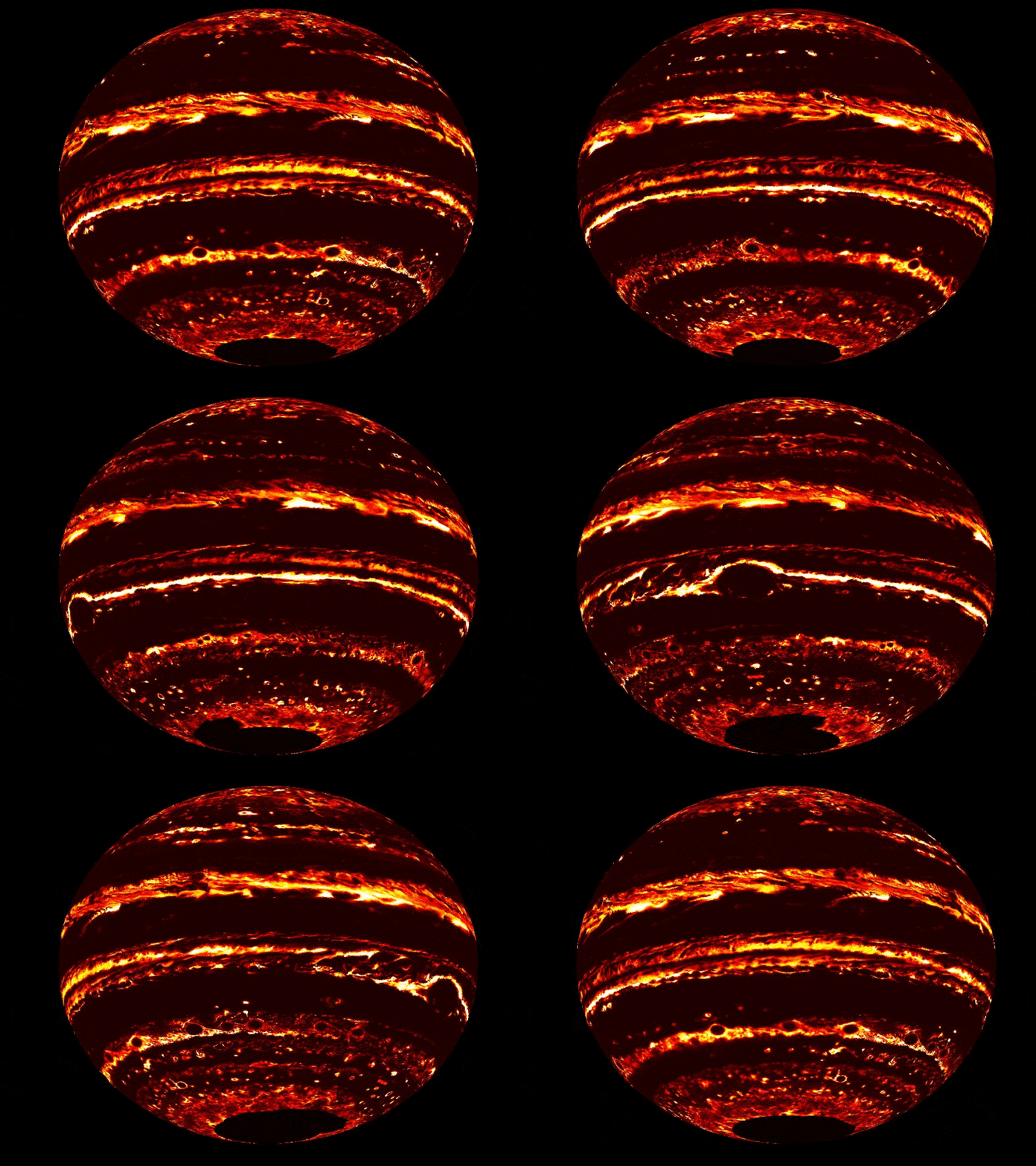
Infra red Jupiter gif

In other news, time travel is again possible , after previously being denounced as impossible due to our linear chronology or something.
Personally I find it all a bit bewildering after all, didn't we invent the concept of time?
Which means that it's our idea, and we can do pretty much anything with it.

Finally, back on Earth...

A sign of the times with a bbc report of a solstice gathering at Stonehenge where drones were banned.
I wonder what our pagan ancestors would have thought of drones - and does it mean that these sixties images were prescient ?


A tribute to the old school flying eye ( Kim LaRoc)
On that note, with even my trusty fan blowing hot air, I say goodbye for now


Saturday, 4 March 2017

Dragon Flies around the Moon, Giant Penguins Once Waddled the Earth, Gifts from NASA


In a gracious gesture, NASA has released free access to software featuring new technologies.
Whizz - kids and Tech-heads will find plenty of inspiration in their PDFs.
The new 'space race' is hotting up as Dragon X announce the first commercial flight around the moon taking place next year, 2018.
Two people will be undergoing health and fitness tests for the milestone journey very soon.
The ultmate goal  for Dragon X is to transport people '...to Mars '.

Mimas  , no Death Star visible....pic NASA/ JPL-Caltech
Even in space with its mind - boggling distances , there are near - misses: recently, the Mars Orbiter had to be course - corrected to avoid collision with Phobos.
This may sound insignificant, but I was taken aback to learn that Mars is a busy ' highway' with no less than five vehicles in orbit.
Which led me to wonder how many were in orbit around our moon , and finally Earth  ( over a thousand )
Even Saturn is being buzzed -  by our intrepid explorer Cassini, which took the photo shown below.
Cassini is currently grazing the ring system around Saturn , observing and preparing for its ultimate demise when it plunges into the gas giant in September.

Saturn pic by Cassini       NASA/ JPL-Caltech
The above image of Saturn was taken by Cassini.
Pause for jaw-dropping fact - each  pixel equates to 37 miles...
 ...that's big.
Saturn is said to be a place where metallic hydrogen exists in the crushing pressure of the atmosphere.
Regarded as a ' Holy Grail ' of chemistry, its status is due to the fact it could be potentially used as rocket fuel, which makes Saturn a re-fuelling stop on the long journey to our next destination.
Attempts have been made to replicate the material under laboratory conditions , which have allegedly succeeded, but unfortunately, the only sample of metallic hydrogen in the world has gone missing .
As you can imagine this has caused great concern.
The extra difficulty in finding the missing sample is that it is one-fifth the thickness of a human hair.
Which is pretty small.
Regardless, though, baffled scientists are currently looking behind curtains and down the side of sofas.
So far, they have found thirty brass coins, a leaky biro pen, a washer , and a ticket to a Level 42 gig .

Meanwhile, back on Earth...

The University of Hong Kong have created a computer simulation of a flying dinosaur with four wings.
Also, fossil evidence of a giant prehistoric penguin  has been found  in New Zealand.

Finally, apropos of nothing,  I found this article very interesting. 


Please note - I have been guilty of occasionally linking to articles in Wikipedia. This has been pointed out as a highly unreliable source of information, which I understand - but in my experience, simple fact - checking against alternate sources is always the way to go. I trust that others will continue to do the same, as I don't intend to patronise my readers . Thank you for being here !
G

Saturday, 5 November 2016

Touchdown , Smackdown , Saturn and Giant Wombats

16 sunrises every day on the ISS


It is now 21 years since the discovery of  the first exoplanet , 51Pegasi B, in the constellation of Pegasus.
Following this find , the number of exoplanets has rocketed ( no pun intended) , and now stands at  approximately 3500 
Whilst many exoplanets are woefully unsuitable for Earth comparisons - 51Pegasi B is a 'hot Jupiter', a tidally locked world that orbits its sun every four days with an average surface temperature of 1200°c .
The figure of 3500 exoplanets gives only a tiny fraction of potentially Earth - like worlds - personally, I think we're wasting precious resources looking for our own reflections.
Are we a world of Narcissists ?
Actually...

NASA celebrates 16 years of the ISS in orbit with the release of an amazing selection of  gifs charting the development of the little 'space colony '.
 A recent touchdown of returning crew from the ISS in Kazakhastan  generated some great photos courtesy of  Bill Ingalls


Returning Soyuz capsule    pic NASA/ Bill Ingalls


Saturn pic Cassini   NASA


The mysterious hexagon , which is bigger than Earth at Saturn's north pole has changed color,
shifting from blue to gold...speculation abounds online that the planet is the solar systems mood-ring.
Meanwhile, it is revealed that Saturns moon Titan is littered with steep- walled canyons filled with liquid methane .
Stunning views and fine sailing for anyone brave enough...seriously though, when Cassini reaches the end of its tenure, there is a proposed submarine mission 


Giovanni Cassini's journals.
He discovered four of  Saturn's moons
between 1671-1684

 Meanwhile on Mars...

The dauntless explorer Curiosity is still roving over the rugged martian landscape.
Its latest find is a meteorite ( known as egg-rock) composed of a nickel / iron mixture .
Whilst it's not exactly big news, I include it here as evidence that NASA are scanning images for even such small oddities - although they obviously missed the squirrel , witchy woman and alien -crab -thingy amongst other uncanny similes.
For those who wish to conduct a post -mortem , the wreckage of the ill- fated Schiaparelli has been imaged by the Mars Orbiter.
I hope that someday the wreckage can be displayed alongside Beagle II and remnants of the many other ill- fated expeditions to the ' Red Planet'.
No doubt the Curiosity rover will be first in line to mock its failed predecessors / rivals in an understated , robotic way

Following the revelation that there are huge amounts of galaxies ( at least two trillion ) in the observable universe, it's the brain- melting number -crunch time again.
Apparently dark matter ( the theoretical crazy-glue of the cosmos) is comprised of trillions of axion particles.
Trillions of axions in every cubic centimeter of the universe.
Ponder.
Feel incredibly small.
Then get annoyed at all the ' ifs' and ' possiblies' associated with what is undoubtedly impressive but almost totally conjectural work.
Personally, I was initially impressed, but increasingly angered by the vagueness of the piece ( see above link).
Perhaps.


MEANWHILE, BACK ON EARTH...

A mysterious 'ping' sound emanating from the seabed in the Arctic is being investigated by the Canadian military .
Early reports dismiss industrial exploration and international subterfuge .
Apparently this ping is pretty serious then , or we're involved in a publicity scam for a new X-files movie....

In the last post, I mentioned the discovery of a hybrid cattle / bison species depicted in cave paintings - now we hear of a discovery indicating that Australia was populated 10 000 years earlier than previously thought.
Evidence has emerged with the discovery of bone fragments, weapons and egg shells in the Australian outback.
The media spin tells us that a man made the discovery when he was caught short and decided to answer the call of nature in a rocky shelter .

Other ancient discoveries recently include what may or may not be a dinosaur brain.
Found some 50 miles from London , ( for the politically inclined, there are dinosaur brains in London , in the Palace of Westminster, which are still functioning in a rudimentary fashion) it is currently being studied as a rare anomaly  (soft tissue tends to degenerate quickly , leaving no trace)  by a Paleobiologist - blimey - first I knew of such a profession !

Finally , a tip of the hat to the tireless writers of  Gizmodo , ( particularly the excellent work of Maddie Stone) , the Planetary org , NASA and  also thanks to you for indulging this weird little micro -blog 
Until next time

G Alias Me


Monday, 11 July 2016

Robotic Stingrays, Vanishing Explorers and Virtual Hunters

This time around, we have a number of  truly strange developments , so we'll begin with something that is almost mundane - it appears that peas can gamble 

Reality trumps fiction as we move casually into the world of living / artificial hybrids, with news of a
robot stingray made from cells taken from a rat.
Making use of low energy propulsion , the robot stingray has odd implications for the future.
They could be used for  aquatic exploration , but also for the underwater exploration of other worlds.
Our solar system is teeming with possible subsurface oceans, so a swimming robotic explorer would be highly prized.
It really ought to have a seriously good camera , too.
Then of course, there is the problem of having nowhere to keep samples - perhaps a tiny backpack ?
which brings us conveniently to the new craze for ' Pokemon Go', an app that strangely enough, is drawing people together, in a bizarre new form of bonding over the hunt for cartoon characters in virtuality

Already, pleas have gone out that people should not play 'Pokemon Go' whilst driving ...
The downside is that this ' alternate reality ' intersects with our own in some potentially dangerous tangents.
Aside from the potential for death by road accident / drowning, it also gives the app massive control of the users online information, so compromised security is a hefty price to pay for your Pikachu...

The teensy Cozmo...          pic Anki
On a similar level, the tiny robot Cozmo is a cute and very capable package, a rover with the power of facial recognition and the ability to take remote control of your room lights and probably other stuff.
So insiduous AI exists, but in packages that may be overlooked as trivial .
Perfect disguise, really...

STOP PRESS !

News just in tells of an encounter between a robot security guard and child in a security mall, resulting in mild bruising for the human child.
Still, the robot uprising has to start somewhere, so why not in a shopping mall in the USA ?
It was good enough for George Romeros zombies...

Meanwhile, somewhere above Mars...

New theories emerge regarding the origins of Mars' moons Phobos and Deimos . I include the link here, but to condense the piece, it suggests that the pair of moons were created following a humungous impact on Mars , long long ago. 

Amidst the frenzy of excitement (well, as frenzied as scientists get) surrounding the potential for life in the subsurface oceans of Enceladus, Europa, Ganymede and Ceres, we have another contender.
 Saturns moon Titan, neglected and unloved, steps up to the plate with new revelations that life could exist there.
Yes, it's an inhospitable deep frozen rocky moon, but apparently the right chemicals are in place for freaky non-waterbased lifeforms.
The mind boggles.

The last thing seen by Hitomi, the ll-fated  Japanese black hole explorer came as a disappointment to me.


Hitomi - final view was the Perseus cluster     pic JAXA
It shows the Perseus cluster , some 249 million light years away, so yes, impressive - but from the wording of the report , it sounded a tad more ominous...perhaps just an image of giant eyeballs...

Meanwhile, further out...

340 light years away - so close, then in universal terms - a planet has been found that defies explanation , as it has three suns.
Take that, Tatooine !
Such a world would almost certainly attract lots of holiday agents - all that guaranteed sunshine !
Endless romantic sunsets !
Infact, it would probaby never get dark...


Friday, 31 July 2015

Spaceship Graveyard

What happens to robot explorers when they die ?

There is no fabled final resting place like the elephants graveyard yet.


Curiosity landing site on Mars. 
Following the Pluto flypast which gave us a plethora of new information (still being assessed / downloaded),
New Horizons is now heading for the Kuiper belt, and with further funding,  possible analysis of another object - before it powers down , leaving us with a hunk of junk drifting in space, billions of miles away.

I personally hope that it continues for many years, but the truth is that we're lucky New Horizons didn't get struck already by space debris - and given the prevalence of random stuff in the Kuiper Belt, the odds are stacked against it.

Image taken from here:


Powered by Plutonium (ho-ho, almost funny), New Horizons is currently set to rendezvous either PT1 or PT3, (PT2 was eliminated).
The difference is that PT1 is smaller, but closer, therefore requiring less fuel, whereas PT3 is bigger but further away.
If the latter is chosen then the flyby is scheduled for 2019, at which point the fuel onboard should expire, and New Horizons will be freefloating.


Sadly for New Horizons, unlike the explorer Cassini, it will not be given a final blast of glory .

Cassini is currently tasked with photographing the moons of Saturn.

Cassini , should it last , will be repeatedly thrust through Saturns rings before plummeting down into its atmosphere at an incredible speed.,
A fiery send off in a blaze of glory, then.

Philae, the much beleagured lander on comet 67P may similarly go out in a blaze as the comet reaches its perihelion with our sun in August, erupting in a halo of ice and flame.

But New Horizons will just become smaller and smaller on the cosmic horizon, until, like Voyagers 1 and 2 before it, it's gone.

At this point, I should say that it qualifies as the first ever craft to approach Pluto system on a flypast, and its discoveries have been unrivalled.


And oh yes, I almost forgot - oops

There's also Curiosity, the Mars lander.
.
Still trundling around the hostile dust-bowl of the Martian surface, dutifully identifying different geological phenomena.

No spectacular ice flows or suchlike for Curiosity, no.

Just strata of quartz and such.

Curiositys progress.

Perhaps Curiosity is harbouring a robot dream of becoming a museum piece, when Mars is colonised.
And people will come to visit,
With their bored children in tow.

 There it will be, Curiosity, shiny and proud, if a little battered and worn.

Part of an exhibit showing the earliest unmanned pioneers of Mars.

Alongside Spirit, Opportunity, Sojourner and the wreckage of Beagle 2.


 Mars Rovers to scale...image from ExtremeTech.com


In fairness, quite a lot of wreckage, as Mars proved almost unassailable for many years.

But I digress.

Beneath that terraformed dome with its buzzing lights and hushed crowd,

I wonder whether anyone will wonder how things are,

back on Earth.


Earth from Mars.