Showing posts with label Europa. Show all posts

Sunday, 15 April 2018

Eyes on Exoworlds, Microbes in Clouds, and Hopping Robots on Asteroids


T.E.S.S. final picture before being prepped for launch
The Transiting Exoplanet Satellite Surveyor will be launched on Monday 16th April (Tomorrow as I write this, but who's counting ?)
Launching from Cape Canaveral, it will add to the search for Earth-like exoplanets currently being scoped by Hubble and Keppler.
It will bridge the (ever-increasing) gap between now and the launch of the James Webb Space Telescope

I find it both commendable but also a good deal of why?
Exoplanets are already bountiful, but the hopes of ever reaching one are painfully slim.
I suppose it helps to identify chemical composition, and make comparisons with our own backwater world. In that respect, it may further our ability to i.d. various chemical signatures in the atmosphere of impossibly distant worlds.
Recently though, Proxima B, a strong exoworld contender, has apparently been subjected to a potentially lethal dose of radiation from its parent star.

Exoplanet transit


Closer to home, we are finding tantalising possibilities of life in our own universe  - the water plumes of Enceladus and the submerged oceans of  Europa to name but two possible contenders; and now there is also the potential of microbes in the clouds of Venus.
The inhospitable surface of Venus has claimed many probes and led to the place being dubbed a hellish world, but the upper atmosphere has potential for further exporation - a floating ' cloud station' has even been mooted. There is also a pending joint America / Russia sortie ( the much delayed Venera -D)

Still remaining in our vicinity - the Japanese explorer Hayabusa 2 is on schedule to collect and return with samples from asteroid Ryugu, having already found and imaged the target - if I'm not mistaken, this is the mission with hopping robots !


Minerva - hopping robot     ISAS

The return of Hayabusa 2 is scheduled for 2020, leaving Osiris- rex lagging behind (it won't get a visual of the target asteroid Bennu until August 2018, and return is scheduled for 2023 ) - but in the spirit of international co-operation, samples will be shared between the two missions.

Apropos of nothing, here is a link to a piece I was going to use as an illustration of spacetime travel, but I ran out of time...

G

It's not just birds that can ' see' the Earths magnetic field - ESA have Swarm on the case, too


The discovery of a galaxy lacking the elusive ' dark matter' has become a contentious issue...


Friday, 6 October 2017

Dusty Stars, Colonies On Mars, And The University That Wasn't


Eugene Cernan, last lunar mission, Apollo 17, 1972

Continuing from last weeks thread about developments in space travel and the race to Mars, it seems that the Trump™ administration has pressured NASA to go with lunar projects, as a 'stepping stone' for Mars.
Given the commercial edge introduced by Elon Musk, it should make for a busy and fruitful time. It's good to see progress - after all, it's been over forty years since the last moon landing.

My Mars boarding pass! Send your name to Mars! Follow the link !

In a blow to the ' Dyson Sphere' theory of the mysterious dimming of Tabbys star, this article tells us of a possible dust-cloud which could have the same effect
Mildly disappointing, but I'm glad that the mystery seems to be solved, rather than wasting time entertaining fantastical theories; speaking of which, a popular conspiracy theory which tied in with cyberpunk 'The Matrix', was the idea that the world we live in is only a computer simulation. Not so, according to physicists at Oxford University. The argument (based on the computational requirements) is convincing. My problem with it is the fact that 'Oxford University' is a matriculation body which oversees the exams for all the colleges in Oxford, it is not a 'university' at all; so the theory that our world does not really exist is disproved by a university that does not really exist.

Dione          (pic by Voyager 2)

Interesting article here about the proliferation of potential ocean worlds in our solar system - including some love for the sadly overlooked Saturnian moon Dione, which was overshadowed by the discovery of plumes of water on Enceladus and Europa.


Wednesday, 21 June 2017

Heatwaves, Lava Waves and Flying Eyeballs

Today is the longest day of the year, and we have a heatwave here in the uk .
In light of which, I decided to write about other hot spots in our neighbourhood.
Just to put things in perspective

The 2018 NASA probe to the sun is to be named in honour of  Eugene Parker, who first theorised that there was a solar wind.
It should give us information on many aspects of our sun, before it succumbs to the inevitable meltdown...

Parker Solar Probe approaching the sun     John Hopkins University

A newly discovered exo-planet is as hot as a star.
So close to its own star that it is tidally locked - but even the side in permanent darkness is a blistering 900 degrees.
Could there be life in such extreme conditions ?
Don't forget there is evidence of a microbe that thrives at 100 degrees c

Saturns north pole  NASA Image processed by Jason Major

The first true colour images from Saturns north pole are pretty nice, having been processed by dedicated citizen scientists, they reveal an almost balmy, tropical look - but don't be fooled, with winds of up to 2000 kmh , this is no tropical paradise - and the air is a mixture of hydrogen and helium.
Looks great though.


thermal anomaly on Europa gives us evidence of sub aquatic conditions which might easily give rise to extremophiles.

Meanwhile, waves of lava have been observed coursing across loki patera, the huge lake on the Jovian moon Io.
Sounds almost idyllic,doesn't it ?
Apart from the blistering heat.
Io is the most geologically active moon in our solar system,
its proximity to Jupiter affecting its orbit and tidal forces.
Tides of molten lava.
Average temperatures 700 - 1.200 c
Not for surfing, then.
I don't think there's even a sunscreen factor for that.

Io - horseshoe-shaped Loki Patera visible    pic NASA


Its a very hot , and lively solar system out there - a far different place than the desolate rocky outpost of my childhood.
It makes me glad that our technoogy has advanced so rapidly, that I can view almost immediate and constant images from Mars, for instance - it feels odd that there was such a gap from the moon landings of the Seventies...

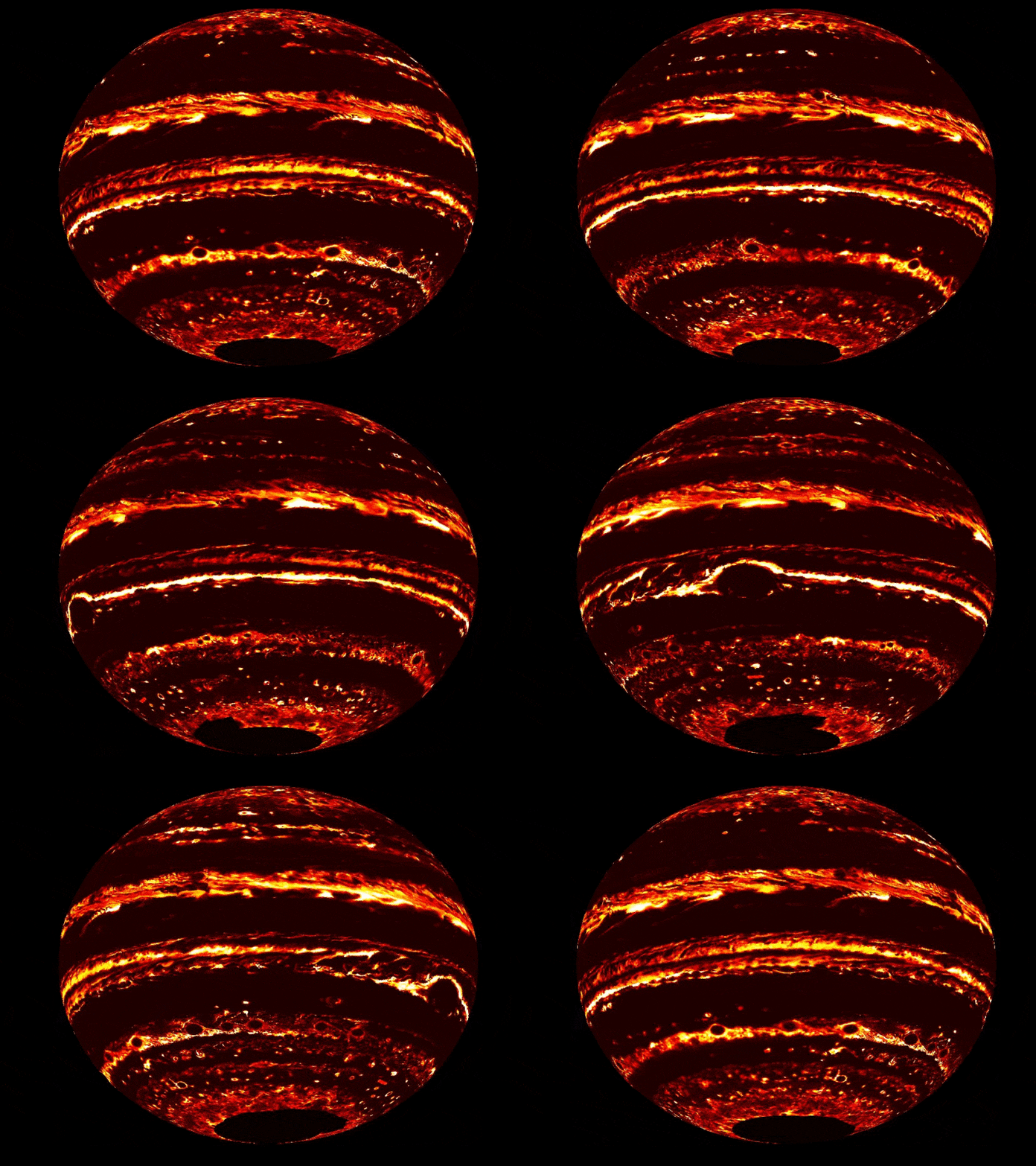
Infra red Jupiter gif

In other news, time travel is again possible , after previously being denounced as impossible due to our linear chronology or something.
Personally I find it all a bit bewildering after all, didn't we invent the concept of time?
Which means that it's our idea, and we can do pretty much anything with it.

Finally, back on Earth...

A sign of the times with a bbc report of a solstice gathering at Stonehenge where drones were banned.
I wonder what our pagan ancestors would have thought of drones - and does it mean that these sixties images were prescient ?


A tribute to the old school flying eye ( Kim LaRoc)
On that note, with even my trusty fan blowing hot air, I say goodbye for now


Friday, 10 March 2017

Glass Creatures, Time Crystals, Mutant Boars, Vanishing Ice, and Europa

A new Fast Radio Burst theory from the Harvard-Smithsonian Center states that maybe, just maybe, they are used by aliens as a propulsion force for space travel.
The downside of this theory is that the 17 FRB signals received so far would hardly propel a fleet of alien spaceships across the cosmos...and using radio-bursts rather than a steady stream of solar / laser light, seems very impractical.

Yeast
Although synthesized Yeast may not be the sexiest example of cutting - edge science, it is being created with the aid of a software program called ' BioStudio ' , and so far, scientists have replicated 6 of 16 chromosomes .
As yeast shares many similarities to our own DNA, it can be used to improve medicines, etc.
This represents a major advance in the field.

Speaking of DNA , scientists have finally discovered the mechanism which allows Tardigrades to be almost indestructible.
Apparently by some trick of their DNA , they collapse, becoming a form of biological glass , with only a bare minimum of molecules and proteins to keep them in suspended animation.
This obviously has implications for deep space travel.
It is almost certain that elements of 'water bear' DNA will eventually be introduced to humans-
or at least, they will to those who need longevity...suddenly that 4.7 light - year journey to Alpha Centauri seems almost possible.

Regardless of whether Tardigrade DNA is copy/pasted into people , molecular damage has probably already occured in the wild boars that now run wild in Fukushima and its environs.
Moves are afoot to convince people to return to the area, but the hostile, and almost certainly radioactive, boars , are the new owners of the place.
The comments section of the article above is filled with discussion of the best calibre guns to take down the mutant hogs...
Mutant hog spotted...
Further to my recent post about the search for absolute zero , a little box is being taken to the ISS this summer with a view to creating the coldest space in the universe, just a fraction of a degree above absolute zero.
It is expected that quantum phenomena will occur - I am excited - and a little worried for the brave souls in the ISS : after all, quantum is where the normal laws of physics break down.
What could possibly go wrong ?

                                                              Artists impression- Nasa Cold Atom Lab


More quantum strangeness - time crystals have been observed, or at least, have now been peer reviewed - opening new possibilities for quantum computing.
Their magic is the way they create a marker or lattice in time itself : a ' rhythm' maintained in the (alleged) fourth dimension.
Initially, this may sound utterly bizarre - a solid object that vibrates on another plane ?
At a basic level, it is the old idea of  perpetual motion , with a twist.


 Meanwhile,in Siberia...

Melting permafrost gave us a scare story some time ago with a potential TB pandemic unleashed from thawed reindeer bodies , but nothing else until now - as the permafost thaws with increasing speed,  large areas are being uncovered and with them new escapes of gases into the atmosphere , and evidence of volcanic activity

Meanwhile, near Saturn...

Pan            photo : Cassini/ Nasa
Anaglyph 3D Pan

Saturns innermost moon, Pan, is tiny, and looks very odd.

Pan was discovered in 1990 from photographs taken by Voyager 2.
Only approximately 17 miles diameter, it orbits Saturn, in the Encke gap of the ring system, and its weird appearance means it is likened to many things including a doughnut, a walnut , and a ufo.

From Saturns inner-most moon to Jupiters possibly life-supporting moon . With the announcement of a NASA mission called Europa Clipper, a reconnaisance craft which will orbit and assess Europa for the essential building blocks of life .
The mission is scheduled to launch in 2020 , arriving at the Jovian moon a few years later.
It will perform 45 orbits of the moon.
The ultimate goal seems to be the colonisation of  Europa- which, coming from NASA themselves, makes me wonder what they are not telling us.
On the other hand, the fact that it concerns Europa gives enough fuel for conspiracies, anyway.

From Europa to Europe

Luxembourg is keen to establish itself as a trailblazer and a
major player in the field of asteroid mining


Staying in the area of Europe, any budding astro-engineers should consider these vacancies from ESA !


P.S.  I realise that the idea of time as a fourth dimension is contentious , but I don't want to get bogged down with the issue, as this is not really a science forum , and my take on the subject is flexible - personally, I think we should expand our dimensions. At least five, and probably ten. Because quantum . But let's agree to differ ?


Saturday, 18 February 2017

Amphibious Drones, Ancient Extremophiles and Superbugs in Space


Amphibious drones are go...

It's hotting up - big money prizes for first team to the moon , and the first to explore the deep sea.
The deep sea contest has a one-day time restriction, and it's got to be done by amphibious drone.
This could be useful for imminent  exploration of other worlds - but as I studied this article, I learned that we have only explored 5% of our own oceans. 
That stopped me in my tracks - mainly because at this point in our jaded , world-weary 21st century we must have explored everywhere on Earth ?
Nope, most of the oceans remain unknown.

Who knows what lurks...           detail from Carta Marina 1572

Exploration is underway in Antarctica , deep inside icy caverns where conditions are similar to Europa (ok, not that similar - temperatures on Europa would be way more frosty at -160°c )
Harsh environments provide serious challenges for exploration , and so JPL have a development facility for monitoring extreme environments , where they are developing robots that can crawl, scurry and climb .
I also learned that there is a department of planetary protection within NASA - is this a conflict of interest ?
Or is it a genuine watchdog for the many exploration methods that are being developed?

Perhaps the most bizarre news in terms of biological matters is that the MRSA bug - the 'superbug' as it was termed by the media in the uk when it created a scare recently, ( ...a bug that you could catch in hospital that was immune to all medicines!) is being sent to the ISS.
We are assured that it will be subject to serious, high-level containment - but anyone with a working knowledge of sci - fi knows how that plays out...

Apparently, space is being upgraded to broadband or something similar , with wider bandwidth enabling bigger images and information packets to be transmitted across the cold vacuum of space.
I'm glad, because I always have problems with my dial-up connection to Pluto.*
Which reminds me that there are many who won't know what I mean by ' dial-up' - and now, I feel old.

...meanwhile, down here on Earth,


  Strange life forms have been discovered embedded in crystals in a system of caves in Naica, Mexico
Dating back some 50 000 years, the living microbes are proof of the resilience of life in extreme environments (the Naica caves are 58°c, 99% humidity).
They are complex microbes, and their DNA differs as much from us , as we differ from mushrooms.
The specimens have been revived in a restricted environment (a lab)
So, that's all right, then , it's not as if we could ever be invaded by rocks...


* At the time of writing, it's 86 years since the discovery of sometime planet Pluto, so, happy birthday!

Friday, 10 February 2017

Robotic Eels, Citizen Satellites, Sky Cranes and The Frozen Lakes Of Mars

Develop and fly your own cube satellite with help from ESA !
Okay, it's not open to individuals , but university groups with a good design , deadline is March 5th, 2017.
Hurrah for ESA !
Citizen Satellites can't be far away...maybe let's practice with drones first.
For the very ambitious, there is the competition to reach the moon and be first to return selfies.
Twenty million dollars for the winner !
The final contestants will begin launching this year !

Whilst I'm impressed that they have developed a chip that can survive the hellish temperatures of the surface of Venus, I can't help wondering why they are so focused on replicating a Curiosity-type rover - surely at such high temperatures a different style is called for
Why not have a hovering rover with extendable probe for surface samples.?
Or a completely separate autonomous drilling  unit ?
Would a drone be feasible , controlled by a remote signal from a satellite in the upper atmosphere ?

This is the problem with astro-physics - for all the compliments paid to the film Interstellar for its realistic depiction of a wormhole, has anyone actually been through one ?
Can a black hole be replicated under lab conditions ?
No, so everything is conjecture.
By the same token we are in danger of imposing limits on our own potential
There is the saying, that 'If it ain't broke, don't fix it.'; which is fine to an extent, but no-one ever pushed the envelope by staying in their comfort zone.
On re-reading this paragraph, I think it is unclear - what I'm trying to say is, let's get wild with spacecraft designs.
I don't want to lapse into business speak with ' blue- sky- thinking -outside- of -the-box', but here's an example of a box to think outside of...

Europa lander...   artist impression      NASA / JPL-Caltech

I'm not saying that landers should be aesthetically pleasing
And I understand that huge doses of radiation from Jupiter is a very real threat, so a shielded box is a smart thing,but...
But there's something - dull about it.
It's retro, but not in a good way.
Even the pareidolia of the robot 'head' looks naff.

STOP PRESS
Further reading tells me that the pictured lander is just an early prototype
It would drill beneath the surface , but only a few inches, as opposed to the miles of drilling needed to reach the ocean,
I stand corrected.
Further details
I'm still not convinced by the drilling theory - I hope further exploration might reveal a hidden shortcut, perhaps a deep gully / ravine, or better still, a system of caves.
My conjecture.

I remember reading of submarine probes based on the fact that any life on Europa is likely to be beneath the waters - even the recently developed robot - eels look appropriately ...alien.
I understand the practical necessity to assess land-based minerals for their extraction value, but are we not limiting our potential in exploration terms ?
Send in a couple of the very cool robotic eels.

There is an issue, of course - given the current attention paid to avoid contaminating potential water sources on Mars , why would we send technology into an alien ocean ?
Is it not running the risk of breaching the Outer Space Treaty ?


Mars continues to confuse.
Curiosity has ample evidence of lake beds which once were filled with fresh water , yet the lack of traceable co2 in the atmosphere suggests the water was always frozen, and never achieved a liquid state . Bizarre...


If you saw the film Gravity, then this picture probably resonates .
It's a photo from the first 'untethered'. spacewalk , showing Bruce McCandless
Not so futuristic after all - this picture is from 1984
Don't panic , he got back safely - phew !


Don't look down