Showing posts with label Jupiter. Show all posts

Monday, 6 November 2017

Sunscreen Rains , The Cameras of Mars, Rogue Worlds And Tiny Suns

I love seeing the sand dunes of Mars, frequently pictured by the MRO.

Beautiful 'linear gullies' on Mars      MRO/NASA/JPL


They  have found a giant planet orbiting a tiny sun , 600 light years away, in the obscure constellation of Columba.
What makes it notable is the bizarre scale (a planet the size of Jupiter orbiting a dwarf star so closely that its year only lasts two days)
Technically, the giant world should not exist at all, especially in such close proximity.
I favour the idea that it is a rogue world, somehow captured by the dwarf sun.
Without an observatory in my vicinity, it's guesswork, but there appear to be a few 'rogue' stars in the constellation.

The Hubble telescope just spotted an exoplanet where it rains sunscreen. At 5000 degrees farenheit, the titanium-oxide rain would hardly be protective...


There is a good deal of excitement at the latest object (A/2017 U1) spotted in our universe -mainly because it appears to have come from another solar system

Indications are that the object is red , similar to Kuiper Belt Object MU69
In which case, is mu69 from another sun , too ?
I find it oddly comforting to know that people are determined to identify and archive these things
 ( thanks to Pedro Lacerda for that link I stumbled across )
The other side of this coin is that we didn't see the asteroid coming, so there is no planned 'sortie' , Bennu style, to gather information about its composition / origins.
Researching this piece led me to this thread from Reddit, which re-affirms my faith in humanity as a curious, knowledge - hungry species...

Red asteroids don't exist- at least, in our solar system- so this points towards A/2017 U1 being an icy, KBO-like object. Why, then, didn't it develop a cometary tail as it passed by the sun? It's honestly confusing. Perhaps the billions? of years it flew through interstellar space drove away all its volatiles?
Clearly there's a lot about the surface composition of interstellar asteroids that we don't know!
[–]FaceDeer 9 points  
I'm very happy to have made it to a portion of history where investigating the composition of interstellar asteroids is a thing.

I also learned about the designation which changed from C2017 U1 to A2017 U1 - from a comet to an asteroid, as it did not exhibit a 'tail', outgassing as it passed the sun.
Apparently this unique little red rock will never pass this way again, it came in from the direction of the constellation Lyra, and was heading out towards the Kuiper Belt .


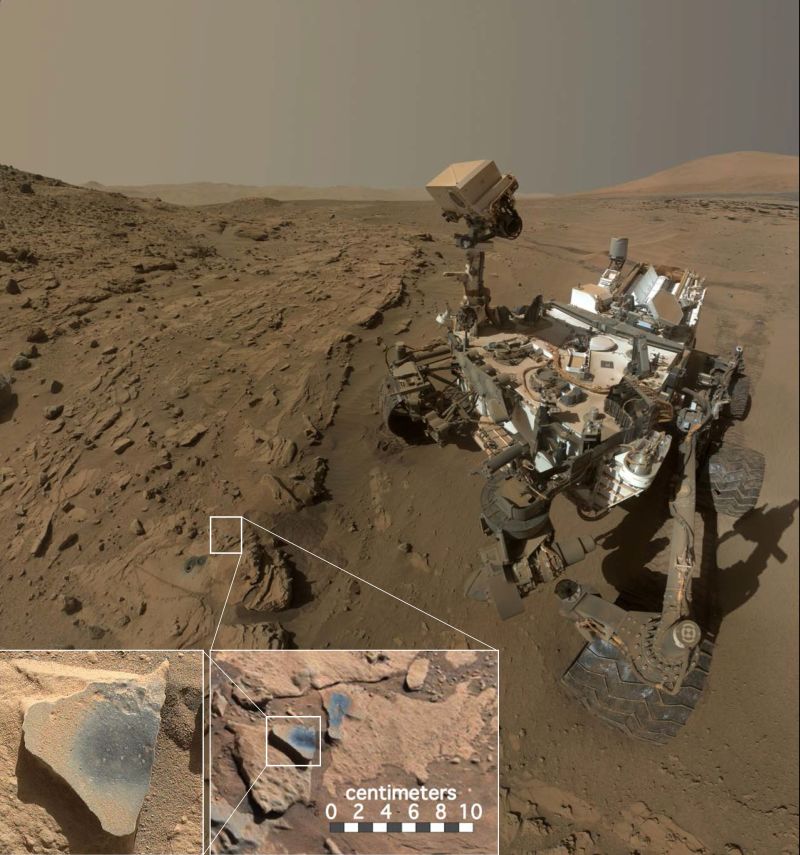
Rearview from Curiosity    NASA/JPL

23 Cameras for the next Mars Mission

In keeping with our current trend for pictures everywhere, the next Mars rover will have 23 cameras - including 3D .
Opportunity rover has a pair of B/W cameras mounted in front to produce stereo images , and another two mounted on the rear of the rover, presumably to monitor bad drivers behind.
The Curiosity rover has 17 camerasThis means that , including the MRO  and Opportunity, there are already 24 cameras on Mars - with another 23 enroute, it won't be long before we have pictures of rovers photographing rovers taking pictures of Mars...

Speaking of rovers armed with cameras,  way back in 1971, the Apollo 17 mission rover had only two cameras and even a compartment for spare film magazines- bulky payloads in the days before Micro sd cards  (although, at least they didn't get so easily lost).
Spare a thought, though, for the nightmare of moon dust in the lens...


Apollo17 Lunar Buggy with ominous ' Secondary life support system'

Please excuse the format problems, I plead ignorance of cut 'n' paste procedure.


G

Saturday, 22 October 2016

Mars Malfunction , Jovian Jollies , Red Rocks and Missing Links

Huge slab of ice found on Mars...        Image : American Geophysical Unit
Mars continues to reveal wonders , with the alleged discovery of a huge slab of ice beneath the surface.
It's actually been quite the week in space. I was planning to create this blog last Wednesday 19th October , in celebration of Exomars arriving at its destination , but - oops , that didn't happen.
Exomars, a two-pronged exploration mission by ESA had only partial success.
The Trace Gas Orbiter is in place, but apparently the Schiaparelli lander had issues with a parachute jettisoning too early. Given that the parachute failed, and the probe entered a freefall reaching a speed of 186mph, the expression ' touch down ' is an understatement.
Further understatement in the BBC report - ' The mood is not positive ' ...


My first response was to wonder why they didn't just aim it at one of the ice caps, letting the heat melt the ice and hopefully absorb some impact that way, but that ignores the Space Treaty and potentially endangers any as yet undiscovered life, I suppose..
That being the case, though, what about the unsuspecting martian who may have been struck by Schiaparelli?
How do we know our puported martian victim is okay ?
There he / she / it  is walking along, minding their own martian business when ka-ding! a lump of hot metal from space...and this one doesn't even have a golden disc with details of where it's from.

Identifying disc from Voyager...

Anyway , the whole Exo-mars thing was really a ' tech demo' , being a dry run for the next mission from ESA , which involves a Curiosity - style rover.
Let's just hope that goes to plan...

Staying with the idea of malfunctioning space probes, earlier in the week , Juno had an issue when two valves opened very slowly , with a resultant loss of a crucial 'window' for a closer orbit (14 days instead of  53.5) around Jupiter .
This means that Juno won't really ' science ' until  Dec 14th, almost two months from now.
If those pesky valves open fast enough.
It makes you realise just how time - sensitive these things are.

Media also tell us of the approach as New Horizons now heads out to Kuiper Belt Object MU 69. The rendezvous is not until 2019 , but we now know that the object appears to be very red.
It seems amazing that we have reached a point in our history where we look for news from an event in the future , rather than now...and quite incredibly , we already know that MU69, a rock drifting a billion miles away in space, is red.
We're not quite advanced enough to determine which particular shade of red, but ...patience is a virtue.
Speaking of space events - I almost missed the news of the two Chinese astronauts reaching their space station.
Pause for a moment - China has a space station ?
Well . yes, but it seems to have happened ' under the radar '. Hmmm
I recall the coverage of the ' Jade Rabbit' moonshot , but a space station ?
Tiangong 1 , known as the ' heavenly palace' is the station.
Anyway, well done China , and a shame on our media bias

Meanwhile back on Earth 

 Palaeontologists have discovered a cave painting that shows some form of ' missing link '- a hybrid between European cattle and the bison.
Again, I must express a little concern - since when did a cave painting become empirical evidence of a species?
I can see it now - deep in a dark cavern in the shadow of retreating glaciers, the neolithic man and his companion are daubing the walls
Hey - I'm drawing a white horse with a horn on its nose. That'll confuse them'
I'm extrapolating of course, but it is surely as likely as a new species defined by 18, 000 year old art scrawled in a dark cavern by flickering torchlight.

Wednesday, 28 September 2016

Hell and High Water

© Flickr / SpaceX

Blimey, we've got a unifying theme this week - well , I think so - on Monday last, NASA announced the discovery of water plumes erupting from the surface of Europa
Personally, I wasn't too impressed, as we'd already heard of similar plumes on Enceladus .
Perhaps the most impressive thing is the sheer scale of the water jets - up to 125 miles / 200 km above surface level.
So, pretty darned impressive.
Enough so that we already have an illustration of a SpaceX craft there.
Of course, the elephant in the room is the fatal dose of radiation levels on Europa , courtesy of  Jupiter .
Not much chance of a quick selfie before imminent death...

Likewise, the recently mooted ocean beneath the surface of Pluto may be up to 62 miles / 99 km deep - That's a lot of sea.
The deepest part of our own oceans is a mere 7 miles / 10 km .
On the subject of oceans,  rising sea levels present a very real threat to NASA
Time to find a new launch pad !
Launch pads could be a wise investment, what with the increasing noise about the colonisation of Mars / the Moon / deep space.
The rockets currently being displayed by Elon Musks Space X and Jeff Bezos Blue Origin appear to be engaged in a ' mine is bigger than yours ' routine, with operational capabilities coming a poor second...
Still, healthy competition can only lead to better designs, surely
Speaking of designs (see what I did there?), it appears that ostrich eggs are marked with protein dna strands going back a long time.
I'm not sure what this means in the greater scheme of things , although there's probably a direct link to a Jurassic World - type scenario, where we happily watch dinosaurs with colourful feathers tearing each other apart.


 From Earth, we move inwards towards Mercury where we have been surprised to learn that there is tectonic activity happening there now - and also, it's shrinking - hardly surprising , with an average daytime temperature of 800 degrees farenheit.
Pretty hellish, then - but still active.
I find it somehow comforting knowing that worlds we previously considered geologically dead, are very much active.
We have Mercury, wilting in the sun, and Pluto with its beating heart is far from being the distant ball of windswept ice that my childhood imagination conjured...

Final frames from Rosetta    © ESA

POSTSCRIPT

Rosetta has ended its mission . After an epic 6 billion-mile journey, the Rosetta craft has descended to the surface of Comet 67P . The media is awash with words like crashlanding, and such - but at only 1 mph, it's hardly a spectacular finale.
Personally, I still wonder why it was not simply left to drift in space , perhaps locked into the comets orbit forever ?
After all, surely theft of industrial secrets isn't an issue in space ?
On the other hand, you can never trust those pesky aliens.
Perhaps we should build a Space Wall...


Wednesday, 7 September 2016

Exploding Payloads, Hellish Planets, Impossible Drives and The Zombie Plague From Space


It's not a great week for Elon Musk as a Space X  Falcon 9 rocket goes up in flames on the launchpad  .
He quickly moved to quash initial reports of an explosion , saying instead that it was a ' fast flame' , which led to some wag continuing the euphemism, by stating that it was a 'fast flame leading to rapid disassembly' .
No-one was hurt, but I imagine the recruitment drive for a manned flight to Mars might suffer.
Mark Zuckerberg was also dismayed as part of the payload was a satellite aimed at bringing the internet to deprived African areas.
Fortunately, there is a 'plan B' , so all should be well.

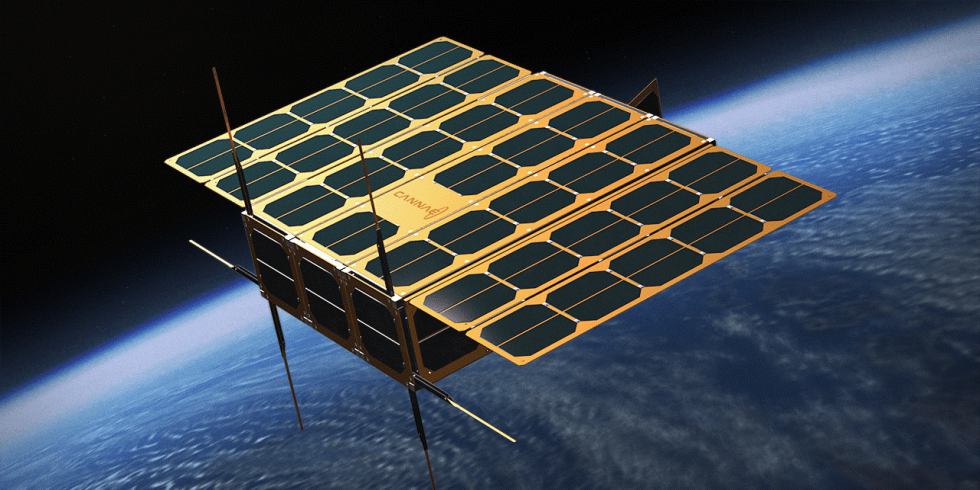
Artist impression    Cannae

Meanwhile, that pesky Emdrive just won't go away.
Infact, not only is it still confounding many (breaking laws of physics) but it is being sent into space for a ' test drive '.
The space-bound version is known as the ' Cannae Drive ', which in Scottish slang, means it's a non-starter, but hey - that's just me being facetious - ahem.
Roger Shawyer is the engineer behind this seemingly impossible drive , which is now being crowdfunded...

Even in space, you can find urban legends.
The idea of a careless employee making a gross miscalculation by using metric instead of imperial units , or vice versa, seems to be a familiar trope -
yet even in an area defined by rigorous testing and peer group reporting, myths can take hold - the report of a failed Venus probe reminds me of something I read years ago - or did I ?
Speaking of hellish planets, further pictures emerge from Juno , currently orbiting Jupiter and attempting to survive its toxic atmosphere...

Southern lights of Jupiter  ( infrared image )   NASA
On September 8th 2016, NASA hope to launch Osiris Rex, heading out to asteroid Bennu, returning with a sample in 2023.
It will be the first ever sample return mission from an asteroid, with plenty of nail-biting moments ahead.
Of course, the media angle is the THREAT to EARTH posed by the asteroid, and comparisons are already being drawn with apocalyptic films ( cue Bruce Willis in a vest gazing into the middle distance).
I laugh at such foolishness, of course, because the REAL threat is from the asteroid sample which will contain the zombie plague from space.

Sticking with the asteroid thing, we end on a high, as they found the plucky little comet- lander Philae, our ill - fated explorer !
Sadly, it's too late in the day for any meaningful contact , as the Rosetta mission draws to a close .
A call has gone up for Rosetta to target Philae when the mission ends later this month (September 2016) so they can at least be reunited for eternity, which is almost touching.
Humanising toys and animals seems to be a fairly widespread  thing, but this is way beyond that...

Still, I'll be watching.
I'll definitely say ' goodbye'
And I'll probably say aww


Friday, 29 July 2016

Dolly the Sheep, the Great Red Spot, and the outbreak of Ancient Disease...


 Farewell to Philae, the ill fated lander . Philae was the first man - made explorer to land on a comet - still there, but inoperative to all intents and purposes.
The mothercraft, Rosetta is still taking and returning photos of the comet, and in September will crash-land on the surface , bringing an end to the mission - leaving us with a legacy of space debris orbiting the universe forever.
Quite a big deal, when you think of it like that.

Remaining with space, we find the alleged solving of the Great Red Spot on Jupiter - okay, it's a storm system as big as two Earths, but it also generates heat in the upper atmosphere, which may explain the temperature similarity to Earth, despite the greater distance from the Sun.
I imagine further revelations will be due very soon, now that Juno has entered orbit around the gas giant.
Did I mention the fact that Juno was the wife of Jupiter in ancient mythology , and that Galileo named its moons after the mistresses of Zeus ?

the only sheep honoured with a plaque...


In other news, the worlds first cloned sheep Dolly died at only 6.5 years old (half the average life expectancy for a sheep) , which created a new fear that clones were short lived .
Luckly though, clones were made of Dolly, and they are all aging normally.
I remember the huge issue surrounding the whole Dolly thing, the idea of 'meddling with nature '  so the news that there are more clones is not at all comforting.
It begs the question, what are they not telling us ?
But don't worry - only four of the tested thirteen clones were derived from Dolly .
So that's okay, then...
I mean if there are 13 cloned sheep (fourteen, counting Dolly), who knows how many cloned people there are ?
Perhaps we should scan photos of Trump rallies more closely.
The temptation is to write 'wake up, sheeple...'


The Siberian permafrost is thawing, global warming in action - the immediate result is an outbreak of anthrax, supposedly from old reindeer corpses .
That's pretty bad, but of course, what else awaits us, hiding in the distant past ?
The Black Death which decimated medieval Europe ?
TB, Polio and other nasties once thought eradicated ?
 It doesn't bear thinking about, so let's lighten the tone...

Hello to new life - yes, apparently even on this old piece of rock there are still surprises, with the recent discovery of new species - specifically beaked whales, which have recently been cropping up around Alaska - eight in total, none of which are previously known about; in the heady rush to colonise / occupy outer space, it seems that we still have vast unexplored swathes of this blue world.
Even our understanding of the world as it once was, is frequently called into question - most recently by the discovery of  minute air bubbles in grains of rock salt - the specimen grains being 815 million years old, it implies far higher oxygen levels in the Earths atmosphere than previously thought.
This in turn means there is a large gap between oxygen and complex lifeforms evolving.
So there would seem to be something else missing from the equation.
Like the time it took for aliens to arrive and give Earth 'the nod'.

ALIEN 1- "This'll do, but let's start with simple forms like aquatic amoebas, sponges and ultimately cephalopods and fish, then land-based murderous creatures."
ALIEN 2 - "Don't you mean humans ?"
ALIEN 1- "Same thing, different Modus Operandi "
- instantly we have intelligent aliens who understand Latin; or at least watched stray galactic transmissions of CSI.
Which brings us neatly to -
Apparently grammar could easily create a barrier to our ability to understand aliens.
Of course, the whole issue could be irrelevant given the continued lack of contact (wired magazine have just explained the Fermi Paradox again, for those who wonder)
I touched on this previously - damnit there I go again, without a decent referential database to mine for past subject matter.
I need a robot to list all my previous subjects on this blog.
Oh, wait, that will be me, then.
Doh


Friday, 1 July 2016

Gas Giants, Helium Balloons and the Arrow of Time


Apparently the hole in the ozone layer is healing, after the virtually global ban on CFCs was introduced some thirty years ago, so yay!
We did something right...
I think the end of the Eighties trend for ' big hair ' probably made a difference, too...

pic: Mary Sue.com
More Good News...

In Tanzania, they have discovered a huge underground source of Helium, so clowns making balloon animals  and stoners talking in funny voices can rejoice !
Seriously though - Helium occurs in abundance throughout the universe, but sadly it is lacking on Earth,  generally only occuring as a byproduct of radioactive decay...so the discovery of a secret stash is good news!

In other news...

Scientists have discovered a new nucleus that points to a certain place in space, which indicates that time is linear, only ever moving forward.
So, no time travel, then.
I find this oddly deflating (certainly for fans of Back To The Future) , but don't forget - it may only be true in our universe!
Which leads me to wonder whether time even exists in other universes.

Mars has Manganese   pic MSS /  NASA

Recent discovery of oxygen whch was once plentiful in the Martian atmosphere paints a picture of a more Earth-like world , especially with its evidence of ancient oceans and lakes.
Speaking of oceans , it seems there may be one beneath the surface of Pluto, following visual cues from New Horizons data ...and vying for recognition in the possible ' water-world' stakes is another dwarf planet, namely Ceres.

Soon to be at a gas giant near you...
Speaking of long distance travel ( do you like the smooth flow of links here?) , after launching way back in 2011, Juno finally arrives at Jupiter on Monday July 4th 2016 ( auspicious date for some ), to begin a survey of  the atmosphere of the gas giant, helping us better understand the mysterious world .
It's a pretty extreme and turbulent ride ahead for the little explorer, so fingers crossed...

Finally, another piece of good news is that funding has been secured for further missions for New Horizons and Dawn , as well as other craft involved in exploration of space .
Positive steps into the unknown !


Thursday, 28 January 2016

The Midnight Rambler and a Cloud called Smith.


There is a cloud called Smith, and it's heading this way at 700,000 miles an hour from the distant outer edge of our galaxy.
It's a gas cloud full of cosmic chemicals, the stuff of stars.
Don't worry though, it's not due to collide with us for another 30 million years, so panic over.
I think I'll be tidying the shed that day.
By all accounts, it will be quite a sight, though, as it could give birth to up to two million stars.
I love these giant space numbers - they remind me of how insignificant I really am, in the greater scheme of things.
Enough navel gazing - the cloud was discovered by Gail Smith , hence the name.

Jupiter image ©NASA / JPL


Apparently the ancient Babylonians used algebra to plot the passage of Jupiter across the night sky, taking its origins (calculus) back some 1500 years.
My personal caution is that we are approaching 'ancient astronauts' territory here, and will next hear of the alien race who bequeathed this knowledge - puts me in mind of the claims regarding the Dogon tribe of Mali.

Remaining on the subject of possible alien interlopers, we are advised that there will be further pictures of the mysterious lights / salts in the craters of Ceres.
The Dawn mission is currently taking images from a new lower orbit of 240 miles. Images thus far look great, but the relevant ones are conspicuous by their absence.

Moscow viewed from ISS  pic ESA / 
Only last night, I saw a photo taken over Moscow which looked not unlike the Occator region - pareidolia possibly, but even so.
I'm still quietly excited.

Occator lights, Ceres   pic NASA / JPL / Caltech


There now follows a close up image of comet 67P Churyumov - Gerasimenko on which the lander Philae has apparently died a cold and lonely death, but will be joined in September when mothership Rosetta finally sets down to become one with the now famous hunk of icy rock as it continues its journey through space.
the comet was originally from the Kuiper belt, until a brush with Jupiter in 1959 knocked it out of it's orbit **, and Jupiter is where we came in, so...

Close up of comet 67P Churyumov - Gerasimenko           23 Jan 2016  ©ESA


* 'they' = the government, obv.
** which makes the comet a 'centaur' technically, as it's a hybrid.

FYI, this post was edited on Feb 5th 2016 to remove my 'midnight ramble' which frankly adds nothing to the post. Thank you all.

By the way, if anyone is wondering about my name change - it's to avoid being labelled a bot on social media - so the initials still mean 'Alias Me', ok ? Thank you !

Sunday, 27 December 2015

Festive Musings, and why The Future is Now


I've been tweaking this post since Boxing Day, in the vain hope that I will suddenly become excited about something.
Gazing outside (there is a small window in this shed) , I notice how un-seasonal the landscape is .
It's really not conducive to the festive feeling.
The festive feeling manifests in many different ways -
One of my brothers, ensconced in a world of 24 / 7 sun and fun, sends photos of Santa hats and champagne on the beach , but whereas that normally conveys a sense of irony, this year, it is lost.
This year has no festive feeling.

There are no snowmen.
There is no frost on the ground.
It's not even proper bloody cold.

Don't get me wrong, I'm not overly attached to sub-zero temperatures and breath freezing in the air and scraping the ice from car windscreens.
But it makes a mockery of the seasonal cards with wrapped - up people scurrying through blizzards of snow , heading home, no doubt for a warming glass of festive punch .
I haven't even seen a robin, so normally associated with Xmas here in Blighty.


Robin pic from here     ©Andy Hay

With a sigh, I turn back to the pile of papers and printouts which litter my desk in the shed.
A piece about the new Star Wars film briefly catches my eye, as it is pinned by a dart to the noticeboard.
I shrug, doubting that my opinion would make a dent on the fannish slavering that surrounds the re-vamped franchise.
Best stick to what I usually do, then.
Perhaps if I wore a silly hat from a cracker, I'd feel more festive.


Seating myself before my trusty old Remington, I lean back, stretch, and crack my knuckles.
And so it begins...


As we head towards the end of 2015, fantastical research abounds all around us.
From a sci-fi app to predict future crimes  (shades of Philip K Dick) to the creation of matter from light ,we are spoiled for moments of wonder.
It's almost enough to melt my cynical heart.
Of course, there is no light without darkness, so this piece cautions against the Fitbit obsession.

We also have the ongoing Ceres and Comet 67p images arriving regularly and New Horizons still dutifully downloading images from the Pluto flyby in July 2015, some of which are being painstakingly fashioned into 3-d anaglyph images , courtesy of the dedicated people at planetary. org
I also hear rumblings of a projected meeting of quantum and relativity branches of physics.
As they are apparently in contradiction, hopefully any meeting will be on neutral territory.
Except, by dint of appearing in the area, it will no longer be neutral.
Oh well...

Space x returns !

On the practical level, I was pleasantly reminded that the future is now,  when I watched the footage of the first successful landing / return of a spacecraft  (okay, just a returning thruster, but even so - in one visual display, the commercial viability of re-usable rockets was displayed.)


Meanwhile back in the Inner Solar System...

On the auspicious date (well, Stateside ) July 4th 2016, the NASA  probe 'Juno' will enter orbit around Jupiter after a five year journey (New Horizons reminds us that it travelled for ten years before arriving at Pluto) - and butting in from somewhere out in inner space, the Japanese probe Akatsuki reminds us that it had to wait five years in limbo before it could retry its Venus insertion (pause for mildly offensive double entendre).

China continues to send data from Jade Rabbit, or Yutsu. still sampling lunar regolith  , from a new-ish crater in the area known as Mare imbrium (new-ish meaning 3 billion years old instead of 4).
The diversity of mineral content  tells us a tale of evolution beyond our own, apparently - ( the general assumption being that the moon was once part of Earth but separated when Earth was struck by a wandering planet about the size of Mars.)
It also tells us that large quantities of Titanium and Hydrogen 3 exist on the moon, so it has the potential for mining fuel for rockets.

Suddenly I am distracted by the sound of happy banter nearby, and I turn away from my musings on outer space.
It's not actually happy banter - it's more of a heated debate.
Specifically , it's the neighbours arguing about the sheer impracticality of hoovering up pine needles as opposed to the benefits of an artificial tree.
I sigh, and switch on the S.A.D. light.
'Tis the Season, after all...


Saturday, 4 July 2015

A Backyard Full of Flybys


Apparently there was flowing water on Mars until about 500,000 years ago.
Evidence is visible in images taken by Curiosity -
It's also what the orbiting craft Maven is looking for :
What caused the atmosphere to dissipate and the water to dry up ?


Was the planet inhabited ?
Did they leave suddenly because of drought ?
Did they come here ?
Are we the descendants of Martians ?

And why so many questions ?

Evidence of waterflow on Mars  Newton crater pic by NASA

Anyway, this idea has moved from the tin - foil realm into 'maybe' territory.
Actually it hasn't - but I like to speculate.

'Speculative fiction' seems to be a new category, although the term was allegedly coined in 1941.
This may have happened in a strange parallel multiverse, and has only now come to light.

I suppose that if the future is now, (as we frequently seem to hear ),
then speculative fiction is closer to now than science - fiction.
It sounds more plausible.
With events being 'Just around the corner'.

500,000 years ago was the last evidence of flowing water on Mars.
About the same time here on Earth, we see evidence of interbreeding in the human fossil record,
As modern man develops from diverse archaic threads...
...food for thought ?

Or just the premise for a hokey sci-fi ?

- Deep breath -

Dr David Miller, chief technological officer at NASA, says we are aiming to colonise Mars now, not
just go for a  visit.

This being the case , are we  returning en - masse to the old homeworld ?
I say 'en -masse', but it will probably be a lottery.
Or like the Hunger Game of Thrones, a fierce challenge
Winner Takes All
Survival of the fittest.


I was going to include a time-line diagram of the development of flight, but I'm no good at technical details, so -

2,400 years ago, kites were invented by the Chinese.

1783 was the year of the first hot air balloon flight (courtesy of the Montgolfier brothers).


The Wright brothers made the first manned aircraft flight in 1903.

The first moon landing was 46 years ago.

Now we are on Mars - well, a couple of robot explorers are.
Also, the lander Philae is riding a comet out there somewhere.
Our first ever landing on a comet

Comets were once considered omens, harbingers of news...

I still find it amazing to think:

We have exploration spacecraft wandering amongst the planets.
As well as Rosetta (Philae mothership),
we have the Mars Orbiter (Curiosity mothership) and Maven
Also Dawn which is orbiting Ceres
Cassini is exploring Saturn and its moons
New Horizons heading to Pluto and beyond .
And Voyager 1 & 2 which are already in the beyond...


Cassini anim using Gimp copyright NASA ?

Pictures from our very first flypast of Pluto will be here imminently.
Whilst New Horizons has been travelling,
Pluto was downgraded from Planet to dwarf planet
and upgraded to Planet again.

Whilst New Horizons has been travelling, we have seen the birth of Facebook and Twitter.

When New Horizons began its trek to Pluto, the International Space Station was not a thing.
Think about that for a moment.
The object orbiting the world with spacemen inside
Now such an everyday accepted fact,
was still in its infancy - the scheduled completion date was 2010.

In 2010, having passed Jupiter,
the New Horizons craft went into hibernation mode.
Finally, after a five year journey, it is awake again
Travelling at 32,000 mph (approximately)
We are mere days away from our first ever proper close-up sight of a world so small and so far away, that it was only discovered by its effects on other bodies.

We are closing in on the heavenly body formerly known as Planet X  (and almost named Percival )

What Pluto actually looks like will no longer be in the realms of Speculative Fiction.

So I'm quite excited...


Latest image  from Ceres showing a couple of bright spots...


P.S. Here is a link to lots of new NASA images
P.P.S. I have forgotten to mention Keppler in my rundown of explorercraft , for which I am sorry .
Keppler is drifting on a wobbly path having lost 2 of its 4 stabilisers.
It continues in its mission to detect potential habitable exoplanets in the 'goldilocks zone'.
It is now on a second mission, known as K2.