Friday, 24 March 2017

Tunnels on the Moon, Martian Landscapes, and the Storms of Jupiter

Investigations have revealed a network of tubes beneath the lunar surface , and arguments abound on whether to explore / inhabit them.
Personally, I think that moment has gone, as all eyes appear to be on Mars...speaking of which -

The diligent Mars explorer Curiosity still rumbles on, but is now showing signs of significant wear and tear on one of its wheels.
Fortunately we can view Mars from afar - this incredible animation was painstakingly pieced together from  available images.
Images from Hubble bring us two distant, interwoven galaxies
Juno is on its fifth Jovian flyby , with some  stunning results

Image from Juno , details here

Recent images from ESA show the many changes on comet 67P, indicating an active geology, surprising for a lump of icy rock in space..
I'm constantly impressed by the quality of images from space, and it's about to get better-
Nasa are working on a system of  ' broadband' for information packets from space.


 ESA have shared this , for those who might want to imagine themselves in the area of a black hole...


A Rant About The New Religion of Atheism

This week, I found myself debating atheism on social media, and being surprised at the arrogance on display -let's not forget that, when connected to the 'Big Bang' , atheism is nothing more than a faith - based belief system - i.e. you have faith that one day, someone will prove the theory.
I'm not impressed by the current wave of 'populism' , short on thinking and long on memes and soundbites, which allows people to parade half - truths as fact.
Ultimately, it harms the very mindset that claims to be advancing the 'clear light' of science,
and it smacks of  'the one true path ', a form of delusion which is normally found in religious zealots.
Science is meant to be a questing thing, a continual search for fact - based evidence, not an endgame.
For instance - has anyone actually managed to replicate a black hole under laboratory conditions ?
No ?
Their existence, then, is a matter of belief / faith...
The whole point of my rant (and thank you for bearing with me), is that quantum  mechanics looms larger by the day, bringing with it a whole new realm of chaos to upset science - from the very notion of 'entanglement' , which Einstein called ' spooky action at a distance', to a  theory that there was no big bang and the universe is eternal.
Regardless of its validity (further debate / testing needed) , it's a new idea, born of quantum science, not an extrapolation of extant physics.

'...nothing is written in stone.'                     pic:    Charlton Heston as Moses


I think the fractious, defensive noise we hear from some corners is insecurity - after all , there are people who have dedicated their lives to proving theories like the big bang.
Those who are genuinely curious either way, await the revelations from the James Webb telescope, which should be able to see as far back in space/time as the afterglow of the alleged Big Bang.
The telescope will be launched into orbit in October 2018.
At least until then, nothing is written in stone.
Including the Ten Commandments and the Big Bang Theory.*


G

* In this universe, it is equally true that The Big Bang Theory is a comedy show about a group of geeks , and The Ten Commandments  is a film by Cecil B DeMille.


Sunday, 19 March 2017

The Whole Earth Telescope, Snarky Submersibles, and Actual Spaceports


Further proof that we are living in the future with the normalisation of the sci-fi phrase ' spaceport '.
Not quite on a par with Mos Eisley, but slowly...
Canada is working towards its first ever spaceport , to be created in Nova Scotia.
Meanwhile NASA is re-purposing Cape Kennedy as a commercial spaceport , capable of supporting multiple launches from private companies .

Messier 87 imaged by Chandra xray observatory

The origins and appearance of black holes beyond supposition and CGI are totally unknown , but soon, we may have an actual image of one.
Using a group of ten telescopes known as EHT, scientists plan to finally get a look at the black hole at the centre of our galaxy .
They are so confident that they predict any image will be in the top ten of all time.
Whether that's the top ten of black hole images, I'm not sure - after all , there's no competition.
Enough of my cynicism , though - if that's not enough, they also aim to image the supermassive black hole (don't you just love these superlatives) at the centre of galaxy M87 .
This monstrosity is equal to 6.6 billion of our sun , and has eaten another galaxy in the last billion years.
Luckily, it's 50 million light years away, although, on a cosmic scale, that's probably too close.
The Event Horizon Telescopes should be functional from next month, April 2017, as soon as telescopes in the Antarctic and the Altacama desert are added to the circuit .

High in the Atacama desert, Chile, a lone rover scours the scorched plains in search of life.
With an average rainfall of less than 1mm a year, the Atacama is the driest place on Earth.
The intrepid rover has to drill into the surface to find those elusive microbes...
The signs are good for the probe KREX 2 , but will it be superceded by PUFFER ?
The rather nippy little ' puffer ' drones would surely be ideal foils for Krex2, or the slow, lumbering, Curiosity rover on Mars...
...speaking of Mars, it appears there may be health problems for humans travelling there.
Scientists are worried about the potential danger of long distance, deep space flight.
Even ' locally ' there could be health issues. 
Esa have started looking into the creation of living units for Mars...
By the way, if you are in the 'Twitter-sphere', a good source of images and entirely spurious / snarky comments is The Sarcastic Rover


Mars - a barren wasteland, or prime real estate ?

High above Mars, the joint ESA / Roskosmos endeavour , the Exomars Orbiter, has commenced its year long aerobraking which will enable it to settle into a circular orbit , some 400 km above the surface.

On the icy Saturnian moon Enceladus, there is evidence of heat beneath the surface in the South Pole - possibly an ocean which interacts with the moons core.
The obvious exploration candidate would be an AUV, possibly working with a surface - based probe as a signal relay.
Perhaps a different name though, eh ?

FUN FACT
Apparently, in naval terms, a submersible is also considered a boat, so the name Boaty McBoatface is perfectly acceptable, although I personally prefer ' Big Metal Floaty Thingy'


Friday, 10 March 2017

Glass Creatures, Time Crystals, Mutant Boars, Vanishing Ice, and Europa

A new Fast Radio Burst theory from the Harvard-Smithsonian Center states that maybe, just maybe, they are used by aliens as a propulsion force for space travel.
The downside of this theory is that the 17 FRB signals received so far would hardly propel a fleet of alien spaceships across the cosmos...and using radio-bursts rather than a steady stream of solar / laser light, seems very impractical.

Yeast
Although synthesized Yeast may not be the sexiest example of cutting - edge science, it is being created with the aid of a software program called ' BioStudio ' , and so far, scientists have replicated 6 of 16 chromosomes .
As yeast shares many similarities to our own DNA, it can be used to improve medicines, etc.
This represents a major advance in the field.

Speaking of DNA , scientists have finally discovered the mechanism which allows Tardigrades to be almost indestructible.
Apparently by some trick of their DNA , they collapse, becoming a form of biological glass , with only a bare minimum of molecules and proteins to keep them in suspended animation.
This obviously has implications for deep space travel.
It is almost certain that elements of 'water bear' DNA will eventually be introduced to humans-
or at least, they will to those who need longevity...suddenly that 4.7 light - year journey to Alpha Centauri seems almost possible.

Regardless of whether Tardigrade DNA is copy/pasted into people , molecular damage has probably already occured in the wild boars that now run wild in Fukushima and its environs.
Moves are afoot to convince people to return to the area, but the hostile, and almost certainly radioactive, boars , are the new owners of the place.
The comments section of the article above is filled with discussion of the best calibre guns to take down the mutant hogs...
Mutant hog spotted...
Further to my recent post about the search for absolute zero , a little box is being taken to the ISS this summer with a view to creating the coldest space in the universe, just a fraction of a degree above absolute zero.
It is expected that quantum phenomena will occur - I am excited - and a little worried for the brave souls in the ISS : after all, quantum is where the normal laws of physics break down.
What could possibly go wrong ?

                                                              Artists impression- Nasa Cold Atom Lab


More quantum strangeness - time crystals have been observed, or at least, have now been peer reviewed - opening new possibilities for quantum computing.
Their magic is the way they create a marker or lattice in time itself : a ' rhythm' maintained in the (alleged) fourth dimension.
Initially, this may sound utterly bizarre - a solid object that vibrates on another plane ?
At a basic level, it is the old idea of  perpetual motion , with a twist.


 Meanwhile,in Siberia...

Melting permafrost gave us a scare story some time ago with a potential TB pandemic unleashed from thawed reindeer bodies , but nothing else until now - as the permafost thaws with increasing speed,  large areas are being uncovered and with them new escapes of gases into the atmosphere , and evidence of volcanic activity

Meanwhile, near Saturn...

Pan            photo : Cassini/ Nasa
Anaglyph 3D Pan

Saturns innermost moon, Pan, is tiny, and looks very odd.

Pan was discovered in 1990 from photographs taken by Voyager 2.
Only approximately 17 miles diameter, it orbits Saturn, in the Encke gap of the ring system, and its weird appearance means it is likened to many things including a doughnut, a walnut , and a ufo.

From Saturns inner-most moon to Jupiters possibly life-supporting moon . With the announcement of a NASA mission called Europa Clipper, a reconnaisance craft which will orbit and assess Europa for the essential building blocks of life .
The mission is scheduled to launch in 2020 , arriving at the Jovian moon a few years later.
It will perform 45 orbits of the moon.
The ultimate goal seems to be the colonisation of  Europa- which, coming from NASA themselves, makes me wonder what they are not telling us.
On the other hand, the fact that it concerns Europa gives enough fuel for conspiracies, anyway.

From Europa to Europe

Luxembourg is keen to establish itself as a trailblazer and a
major player in the field of asteroid mining


Staying in the area of Europe, any budding astro-engineers should consider these vacancies from ESA !


P.S.  I realise that the idea of time as a fourth dimension is contentious , but I don't want to get bogged down with the issue, as this is not really a science forum , and my take on the subject is flexible - personally, I think we should expand our dimensions. At least five, and probably ten. Because quantum . But let's agree to differ ?


Saturday, 4 March 2017

Dragon Flies around the Moon, Giant Penguins Once Waddled the Earth, Gifts from NASA


In a gracious gesture, NASA has released free access to software featuring new technologies.
Whizz - kids and Tech-heads will find plenty of inspiration in their PDFs.
The new 'space race' is hotting up as Dragon X announce the first commercial flight around the moon taking place next year, 2018.
Two people will be undergoing health and fitness tests for the milestone journey very soon.
The ultmate goal  for Dragon X is to transport people '...to Mars '.

Mimas  , no Death Star visible....pic NASA/ JPL-Caltech
Even in space with its mind - boggling distances , there are near - misses: recently, the Mars Orbiter had to be course - corrected to avoid collision with Phobos.
This may sound insignificant, but I was taken aback to learn that Mars is a busy ' highway' with no less than five vehicles in orbit.
Which led me to wonder how many were in orbit around our moon , and finally Earth  ( over a thousand )
Even Saturn is being buzzed -  by our intrepid explorer Cassini, which took the photo shown below.
Cassini is currently grazing the ring system around Saturn , observing and preparing for its ultimate demise when it plunges into the gas giant in September.

Saturn pic by Cassini       NASA/ JPL-Caltech
The above image of Saturn was taken by Cassini.
Pause for jaw-dropping fact - each  pixel equates to 37 miles...
 ...that's big.
Saturn is said to be a place where metallic hydrogen exists in the crushing pressure of the atmosphere.
Regarded as a ' Holy Grail ' of chemistry, its status is due to the fact it could be potentially used as rocket fuel, which makes Saturn a re-fuelling stop on the long journey to our next destination.
Attempts have been made to replicate the material under laboratory conditions , which have allegedly succeeded, but unfortunately, the only sample of metallic hydrogen in the world has gone missing .
As you can imagine this has caused great concern.
The extra difficulty in finding the missing sample is that it is one-fifth the thickness of a human hair.
Which is pretty small.
Regardless, though, baffled scientists are currently looking behind curtains and down the side of sofas.
So far, they have found thirty brass coins, a leaky biro pen, a washer , and a ticket to a Level 42 gig .

Meanwhile, back on Earth...

The University of Hong Kong have created a computer simulation of a flying dinosaur with four wings.
Also, fossil evidence of a giant prehistoric penguin  has been found  in New Zealand.

Finally, apropos of nothing,  I found this article very interesting. 


Please note - I have been guilty of occasionally linking to articles in Wikipedia. This has been pointed out as a highly unreliable source of information, which I understand - but in my experience, simple fact - checking against alternate sources is always the way to go. I trust that others will continue to do the same, as I don't intend to patronise my readers . Thank you for being here !
G

Saturday, 25 February 2017

Pseudo - Mammoths and Pedantic Planets


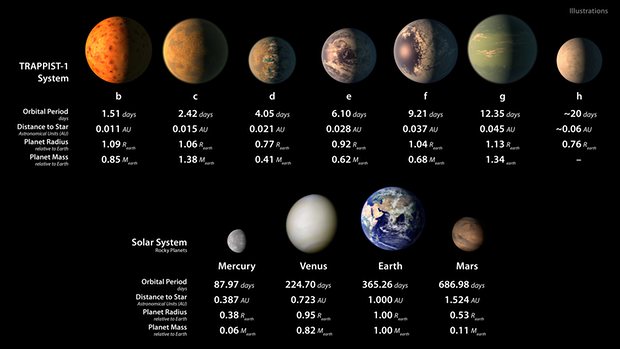
Seven Earth-sized planets ?                     image: NASA/JPL/ Caltech

Call me picky, but I'm already tired of reading headlines that say NASA found seven earth- sized planets.
Time to address my inner pedant -
Of the seven planets found, only three of them are in the goldilocks zone of potentially habitable worlds around their parent star , and only one of them is Earth-sized.
Fact.
If that makes me a party - pooping pedant, then so be it.
It's a great discovery, and certainly provides a focus for future science and exploration
But
They are also forty light years away
Which is not to be sniffed at.
My first reaction was that we should point a radio mast and send a signal out there
Which is great until you realise that your excitement would have to last for eighty years to get the signal back along with any message they might attach.
That's if  they respond immediately
And that is if they even exist
What if there's no-one there ?
Eighty years is a long time to wait for silence.
On the other hand - nothing ventured, nothing gained; 
and we  Earthlings are nothing if not curious.
I imagine plans are already afoot - after all with seven ( possibly more ) worlds to choose from...

Curiosity       image NASA / JPL-Caltech

So let's be positive - another NASA initiative is to use metal extracted from Mars to construct habitats, thus saving precious fuel and money .
I don't have anything more to discuss regarding Mars, ( I haven't even seen the film with Mr Damon*) but a dedicated planetary scientist published the above image of the Curiosity rover , taken at  (Martian)  sunset recently - which looks like a studio shot , or CGI.
Conspiracy a-go-go !


Human eyes are best for spotting 'planet nine'
....

With the demotion of Pluto to dwarf planet, there's still a planetary gap to be filled.
There is a candidate for a ninth planet , but it is so far away that it has not yet been found.
A new project allows citizen scientists to look for it.
Personally, I say we should still regard Pluto as the ninth planet.
Why ?
Because the new candidate is so far away that one orbit of the sun is estimated at 10 - 20 000 years.
That's a l-o-o-ong way out.
Whereas, we've already been to Pluto
New Horizons didn't actually leave a flag saying 'Property of Earth ',
but I grew up convinced of this distant little planet being part of our solar system
Okay so it hasn't cleared its orbit of debris  (that pesky kuiper belt), which disquaifies it from being a planet - even so, the whole planetary criteria thing was introduced in 2006 , by which time, Pluto had been a recognised planet for 76 years.
I say that what's done is done.


Back on Earth...


Interesting article here , although I despair at the clumsy word 'de-extinction ' ...
Anyway, the gist of the piece is that an  elephant / mammoth hybrid may be possible, which raises all sorts of moral questions; in this age of concern over animal welfare , do we really want to focus on novelty over practicality ?
If so , why not create a whole herd, after all these were gregarious creatures .
Then of course, there's the inevitable Jurassic Park question.
At which point, I say farewell until next time...


*- but I have seen Arrival and Interstellar

Tuesday, 21 February 2017

Why Not Ceres ?

Ceres 

I was conflicted about making this post for many reasons, mainly because I don't do mid-week posts, but here we are.
I decided to write this in advance of the proposed N.A.S.A. news release on 22nd Feb - not to ' rain on their parade' , but rather, to enhance the experience.
After all, the proverbial cat is out of the bag already, and I think the leak emanates from somewhere in Europe (details of the whole thing here ).
Personally, I'm disappointed, as it overshadows the quite astonishing news that organic matter has been found on the planetoid , Ceres.
Remember the Dawn explorer , and my previous excitement over the mysterious bright patches which turned out to be forms of salt from subsurface waters ?
Yes ?
Well. not those.
Apparently these organic materials are in an area surrounding a particular crater.
This is not the place to embark on fanciful theorising; but why should organic matter exist in one particular area ?
If the material is from a subsurface body of water, why is there no trace in other areas ?
I'm already letting my feverish monkey - brain get excited by a myriad of possibilities , but this, to me, is a perfect reason to explore further.
Ceres is the largest body in the asteroid belt between Mars and Jupiter, and I would argue that it warrants closer investigation - if the only concern is cost, it would surely be a fraction of any Mars expedition.
The previous link is a fanciful Bloomberg piece of speculation, but the idea is there.
Let's just concentrate on exploration rather than the plundering of minerals - after all , the assumption that it's there for the taking smacks of colonial era greed and ignorance - but we're better than that, right ?

Regardless, N.A.S.A. will probably tell us of the three Earth-like worlds orbiting a red dwarf  some 40 light years away; and that is genuinely exciting, especially when the chance of extraterrestrial life is introduced , but even with our best speculative technology, it would take us 60 years in a craft with an immense lightsail to get there, and only then if we could upscale the technology to make it a manned mission, rather than a postage stamp - sized craft.

Just to conclude, this post is my response to the imminent N.A.S.A. announcement - I think they are missing a point closer to home .
Ceres is on a par with Europa, Titan and Enceladus in the ongoing search for life.


Thank you for reading this far - normal service will be resumed in a few days !


Saturday, 18 February 2017

Amphibious Drones, Ancient Extremophiles and Superbugs in Space


Amphibious drones are go...

It's hotting up - big money prizes for first team to the moon , and the first to explore the deep sea.
The deep sea contest has a one-day time restriction, and it's got to be done by amphibious drone.
This could be useful for imminent  exploration of other worlds - but as I studied this article, I learned that we have only explored 5% of our own oceans. 
That stopped me in my tracks - mainly because at this point in our jaded , world-weary 21st century we must have explored everywhere on Earth ?
Nope, most of the oceans remain unknown.

Who knows what lurks...           detail from Carta Marina 1572

Exploration is underway in Antarctica , deep inside icy caverns where conditions are similar to Europa (ok, not that similar - temperatures on Europa would be way more frosty at -160°c )
Harsh environments provide serious challenges for exploration , and so JPL have a development facility for monitoring extreme environments , where they are developing robots that can crawl, scurry and climb .
I also learned that there is a department of planetary protection within NASA - is this a conflict of interest ?
Or is it a genuine watchdog for the many exploration methods that are being developed?

Perhaps the most bizarre news in terms of biological matters is that the MRSA bug - the 'superbug' as it was termed by the media in the uk when it created a scare recently, ( ...a bug that you could catch in hospital that was immune to all medicines!) is being sent to the ISS.
We are assured that it will be subject to serious, high-level containment - but anyone with a working knowledge of sci - fi knows how that plays out...

Apparently, space is being upgraded to broadband or something similar , with wider bandwidth enabling bigger images and information packets to be transmitted across the cold vacuum of space.
I'm glad, because I always have problems with my dial-up connection to Pluto.*
Which reminds me that there are many who won't know what I mean by ' dial-up' - and now, I feel old.

...meanwhile, down here on Earth,


  Strange life forms have been discovered embedded in crystals in a system of caves in Naica, Mexico
Dating back some 50 000 years, the living microbes are proof of the resilience of life in extreme environments (the Naica caves are 58°c, 99% humidity).
They are complex microbes, and their DNA differs as much from us , as we differ from mushrooms.
The specimens have been revived in a restricted environment (a lab)
So, that's all right, then , it's not as if we could ever be invaded by rocks...


* At the time of writing, it's 86 years since the discovery of sometime planet Pluto, so, happy birthday!